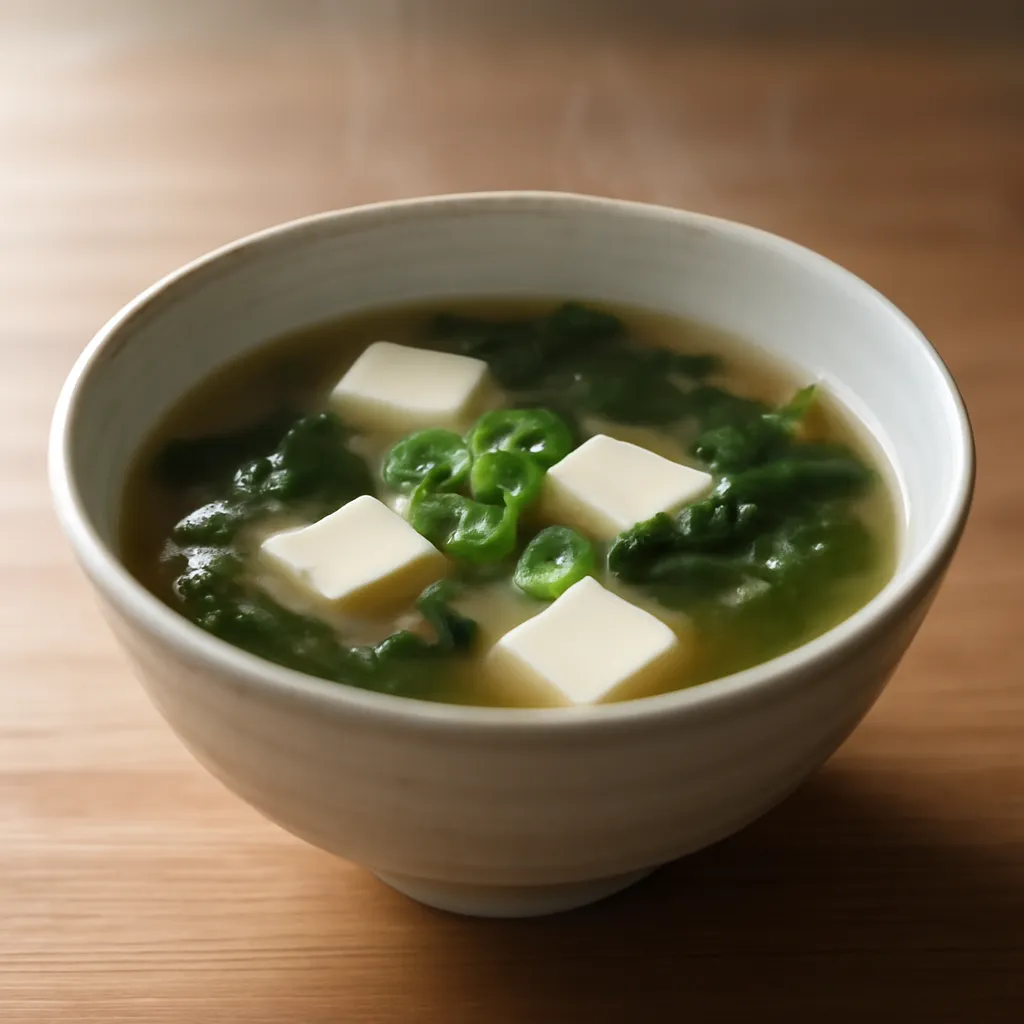
A gentle, savoury Japanese soup built on a proper kombu and bonito dashi, then loosened with miso and dotted with silken tofu, wakame and spring onion. It is quick, comforting and deeply umami. The golden rule: keep the miso just below a simmer so it stays alive and aromatic.
Good miso soup is all about restraint. You want a clean, savoury dashi carrying soft tofu and wakame, with the miso stirred in off the boil so it keeps its gentle sweetness and aroma. It takes minutes, uses a handful of storecupboard Japanese ingredients, and makes a soothing starter or light lunch alongside rice and pickles.
Ingredients
Method
- Wipe the kombu with a damp cloth, leaving any white bloom (that is umami). Put it in a pan with the cold water and leave to steep for 10 minutes if you have time, then set over a low-medium heat.
- Bring the water slowly towards a simmer. Just before it boils and small bubbles rise, lift out the kombu and discard it; boiling kombu turns the dashi bitter and slimy.
- Add the bonito flakes, let the liquid come to a brief simmer, then turn off the heat and leave for 2 minutes so the flakes sink. Strain the dashi through a fine sieve and return the clear stock to the rinsed pan.
- Meanwhile, soak the wakame in a little cold water for 5 minutes until soft and swollen, then drain.
- Warm the dashi over a low heat. Add the tofu cubes and drained wakame and heat through gently for 2 minutes; do not let it boil hard or the tofu will break up.
- Put the miso in a small bowl or ladle, add a couple of spoonfuls of the hot dashi and whisk with chopsticks or a fork until smooth, then stir it back into the pan.
- Keep the soup just below a simmer and never let it boil once the miso is in, or you will lose the aroma. Taste and add the soy sauce only if it needs more depth.
- Ladle into bowls, scatter with spring onions and serve straight away while fragrant.
Serve it with
- Steamed Japanese short-grain rice
- Salmon teriyaki or grilled mackerel
- Cucumber and sesame salad
- Japanese pickles (tsukemono)
- Chicken katsu or tofu katsu
Why this works
Kombu gives glutamate and bonito gives inosinate; together they create a powerful umami synergy that makes the broth taste rich without any meat. Adding the miso off the boil preserves its volatile aromas and living cultures.
Common swaps
- Use dashi powder (1 tsp in 1 litre hot water) to skip the kombu and bonito entirely
- Swap silken tofu for firm tofu if you prefer it to hold its shape
- Replace wakame with a few leaves of baby spinach stirred in at the end
- Use red (aka) miso for a bolder, saltier soup, reducing the quantity slightly
Common mistakes to avoid
- Boiling the soup after adding miso, which flattens the flavour and dulls the aroma
- Letting the kombu boil, making the dashi bitter and slippery
- Adding miso straight to the pan so it clumps, rather than loosening it first in a little stock
- Over-seasoning; miso is already salty, so taste before reaching for soy sauce
Storage, freezing & reheating
Storage: Best eaten fresh. Cool any leftovers quickly and keep in the fridge for up to 2 days, then reheat gently.
Reheating: Warm slowly in a pan over a low heat until steaming but not boiling; heating too fiercely spoils the miso's flavour and breaks up the tofu.
Allergen notes: contains Fish, Soya. Always check individual product labels.
Estimated nutrition
Per serving, estimated from typical ingredient values — not a substitute for precise dietary calculation.
| Calories | 90 kcal |
|---|---|
| Protein | 7 g |
| Carbohydrate | 6 g |
| Fat | 4 g |