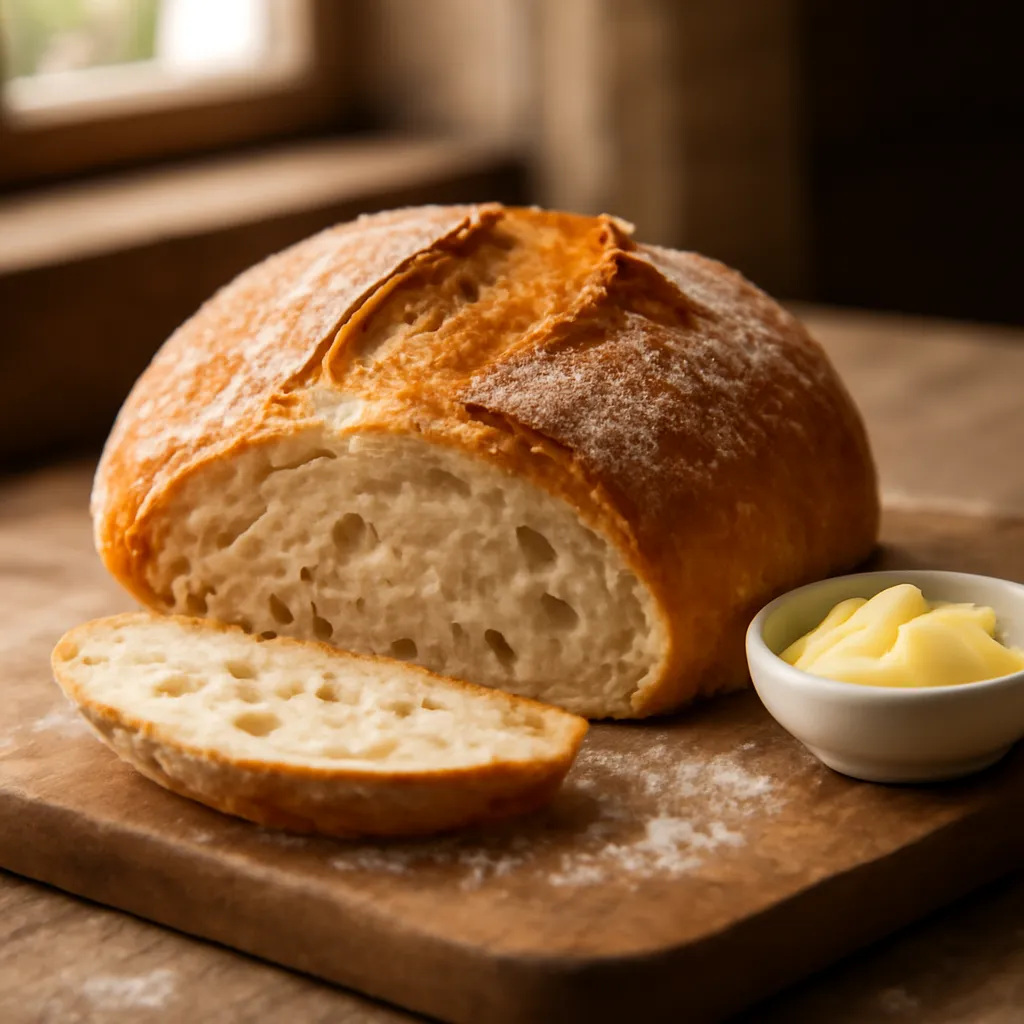
This is the loaf that made home bakers everywhere throw out the bread machine. A wet dough and a long, slow rise do all the work, so you get a shatteringly crisp crust and a soft, airy crumb with almost no effort. Baking in a preheated casserole traps the steam for that professional finish.
Forget aching arms and flour-dusted worktops. No-knead bread lets time and a slack, wet dough build the gluten for you overnight. The next day you shape it in seconds and bake it inside a lidded pot, which mimics a steam-injected bakery oven. The reward is a rustic loaf with a crackling crust and a tender, holey crumb.
Ingredients
Method
- In a large bowl, whisk together both flours, the yeast and the salt. Pour in the water (and honey, if using) and stir with a wooden spoon until you have a shaggy, sticky dough with no dry flour left. It should look wet and rough — resist adding more flour.
- Cover the bowl tightly with a plate or cling film and leave at cool room temperature for 12 to 18 hours, until the surface is bubbly and the dough has more than doubled. A long, cool rise builds the flavour and structure.
- Tip the dough onto a well-floured surface — it will be loose and airy. With floured hands, fold the edges into the middle a few times to form a rough ball, then flip it seam-side down. Don't knock out too much air.
- Dust a sheet of baking paper with the semolina and sit the dough on top, seam-side down. Cover loosely and leave to prove for 45 minutes to 1 hour while the oven heats.
- Meanwhile, put a lidded cast-iron casserole (about 24cm) into the oven and heat to 230°C fan / 250°C / gas 9 for at least 30 minutes, so the pot is fiercely hot.
- Slash the top of the loaf with a sharp knife or blade. Carefully lift out the hot pot, lower in the dough using the paper as a sling, and clamp on the lid. Watch your hands — the pot is extremely hot.
- Bake with the lid on for 30 minutes, then remove the lid and bake for a further 12 to 15 minutes until deep golden and crackling. The loaf should sound hollow when tapped underneath.
- Lift onto a wire rack and leave to cool for at least 45 minutes before slicing. Cutting too soon gives a gummy crumb — the loaf is still cooking inside as it cools.
Serve it with
- Salted butter and good jam
- A wedge of mature Cheddar and chutney
- Steaming bowls of soup
- Olive oil and balsamic for dipping
- Softly scrambled eggs
Why this works
The very wet dough and long fermentation let gluten develop on its own, no kneading required, while the preheated lidded pot traps escaping steam to set a thin, glassy crust before the loaf springs and browns.
Common swaps
- Swap the wholemeal for rye flour for an earthier, darker loaf
- Fold in 75g olives or 50g grated Cheddar with a pinch of thyme after mixing
- Use all strong white flour for a lighter, milder crumb
- No casserole? Bake on a hot tray with a roasting tin of boiling water below for steam
Common mistakes to avoid
- Adding extra flour because the dough feels too wet — the wetness is what creates the open crumb
- Slicing while still warm, which makes the inside gummy and dense
- Not preheating the pot long enough, so the crust never crisps
- Rushing the first rise; it genuinely needs 12 hours or more to develop flavour
Storage, freezing & reheating
Storage: Keep cut-side down on a board, or wrapped in a clean tea towel, at room temperature for up to 3 days. Avoid the fridge, which dries bread out and makes it stale faster.
Freezing: Freezes brilliantly. Slice first, freeze in a bag for up to 3 months, and toast straight from frozen.
Reheating: Refresh a whole loaf in a 180°C oven for 8 to 10 minutes to crisp the crust, or toast individual slices.
Allergen notes: contains Gluten. Always check individual product labels.
Estimated nutrition
Per serving, estimated from typical ingredient values — not a substitute for precise dietary calculation.
| Calories | 215 kcal |
|---|---|
| Protein | 7g |
| Carbohydrate | 44g |
| Fat | 1g |