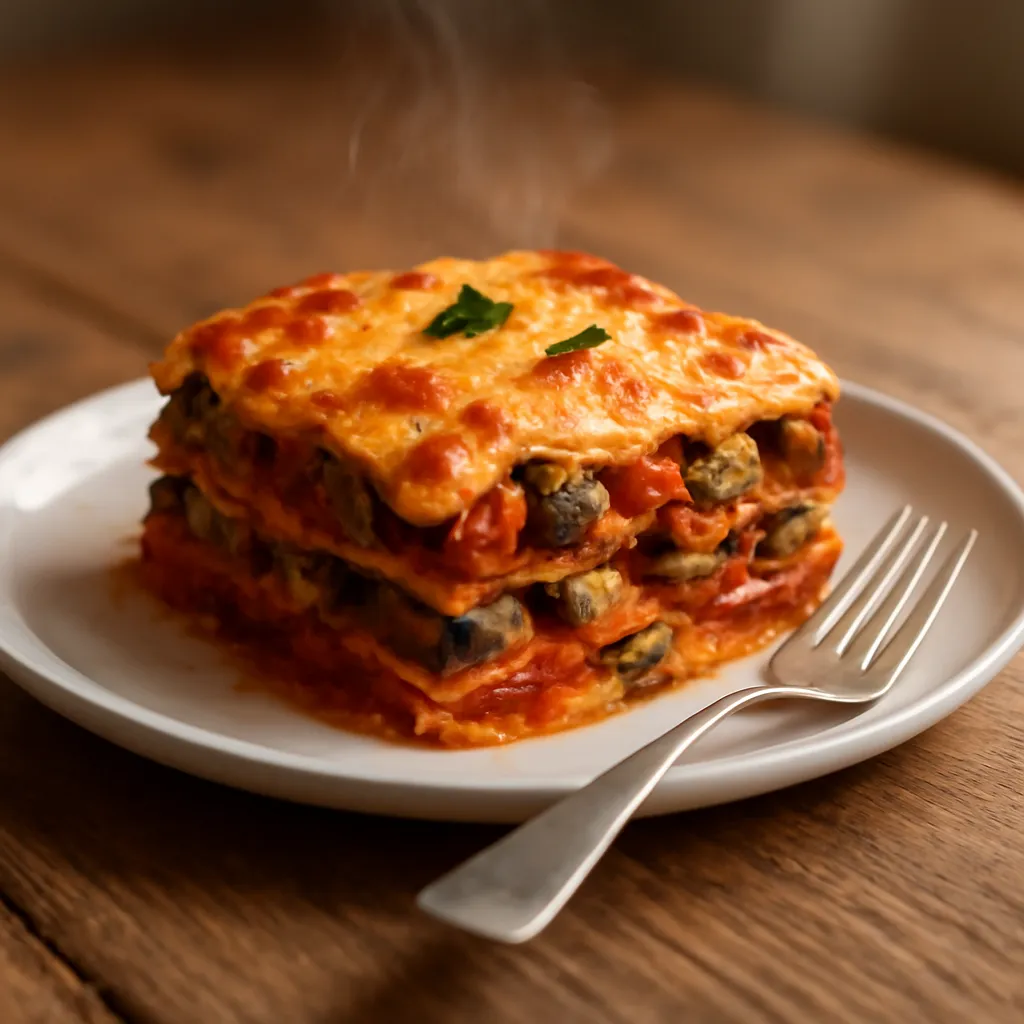
This vegetable lasagne stacks roasted courgette, pepper and aubergine into a rich tomato ragu, topped with silky bechamel and bubbling cheese. It is proper comfort food that happens to be meatless, and it feeds a hungry table of six with ease.
A good vegetable lasagne needs more than a heap of soft veg between the sheets. Roasting the courgette, aubergine and peppers first drives off water and deepens their flavour, so the finished dish is rich rather than watery. Layered with a garlicky tomato sauce and a proper bechamel, it is the kind of meat-free meal nobody misses the meat in.
Ingredients
Method
- Heat the oven to 200C/180C fan/gas 6. Toss the courgette, aubergine, peppers and onion with 2 tbsp of the olive oil and a good pinch of salt on a large baking tray. Roast for 25 minutes, stirring once, until softened and lightly caramelised.
- Meanwhile, warm the remaining oil in a saucepan and soften the garlic for 30 seconds. Add the chopped tomatoes, tomato puree and oregano, then simmer for 15 minutes until thickened. Stir the roasted vegetables through the sauce and season to taste.
- For the bechamel, melt the butter in a separate pan, stir in the flour and cook for 1 minute. Gradually whisk in the milk, a splash at a time, then cook gently for 5 minutes until smooth and thick enough to coat the back of a spoon. Season with salt, pepper and a little grated nutmeg.
- Spoon a third of the vegetable sauce into a large ovenproof dish and cover with a layer of lasagne sheets. Repeat twice more, breaking sheets to fit as needed, finishing with a layer of pasta on top.
- Pour over the bechamel, spreading it to the edges so it covers the pasta completely, then scatter over the grated cheese.
- Bake for 45 minutes until the top is golden and bubbling and a knife slides easily through the centre. Rest for 10 minutes before cutting so the layers set.
Serve it with
- A crisp green salad with a sharp vinaigrette
- Warm garlic bread or ciabatta
- A glass of light red wine
- Simple dressed rocket with shaved parmesan
Why this works
Roasting the vegetables before saucing them removes excess moisture, which is the usual reason veggie lasagne turns out sloppy. A homemade bechamel then binds the layers with a richness that jarred white sauce can't match.
Common swaps
- Swap the aubergine for a couple of handfuls of spinach, wilted and squeezed dry, stirred through the sauce.
- Use mushrooms and butternut squash in place of the peppers for an autumnal version.
- For a lighter top, use ricotta beaten with an egg instead of bechamel.
- Vegans can use a plant-based butter, oat milk and dairy-free cheese throughout.
Common mistakes to avoid
- Skipping the roasting step, which leaves the vegetables raw-tasting and watery.
- Making the bechamel too thin, so it sinks into the pasta instead of forming a golden crust.
- Not covering the top pasta layer fully with sauce, leaving dry, hard edges.
- Cutting straight from the oven so the layers collapse into a heap.
Storage, freezing & reheating
Storage: Keep leftovers covered in the fridge for up to 3 days. Cut into portions once fully cooled for easy reheating.
Freezing: Freezes well for up to 3 months, either whole or in portions. Cool completely, wrap tightly and freeze; defrost fully in the fridge before reheating.
Reheating: Reheat individual portions in the microwave until piping hot, or cover with foil and warm in a 180C oven for 20-25 minutes.
Allergen notes: contains Milk, Gluten. Always check individual product labels.
Estimated nutrition
Per serving, estimated from typical ingredient values — not a substitute for precise dietary calculation.
| Calories | 420 kcal |
|---|---|
| Protein | 16 g |
| Carbohydrate | 45 g |
| Fat | 20 g |