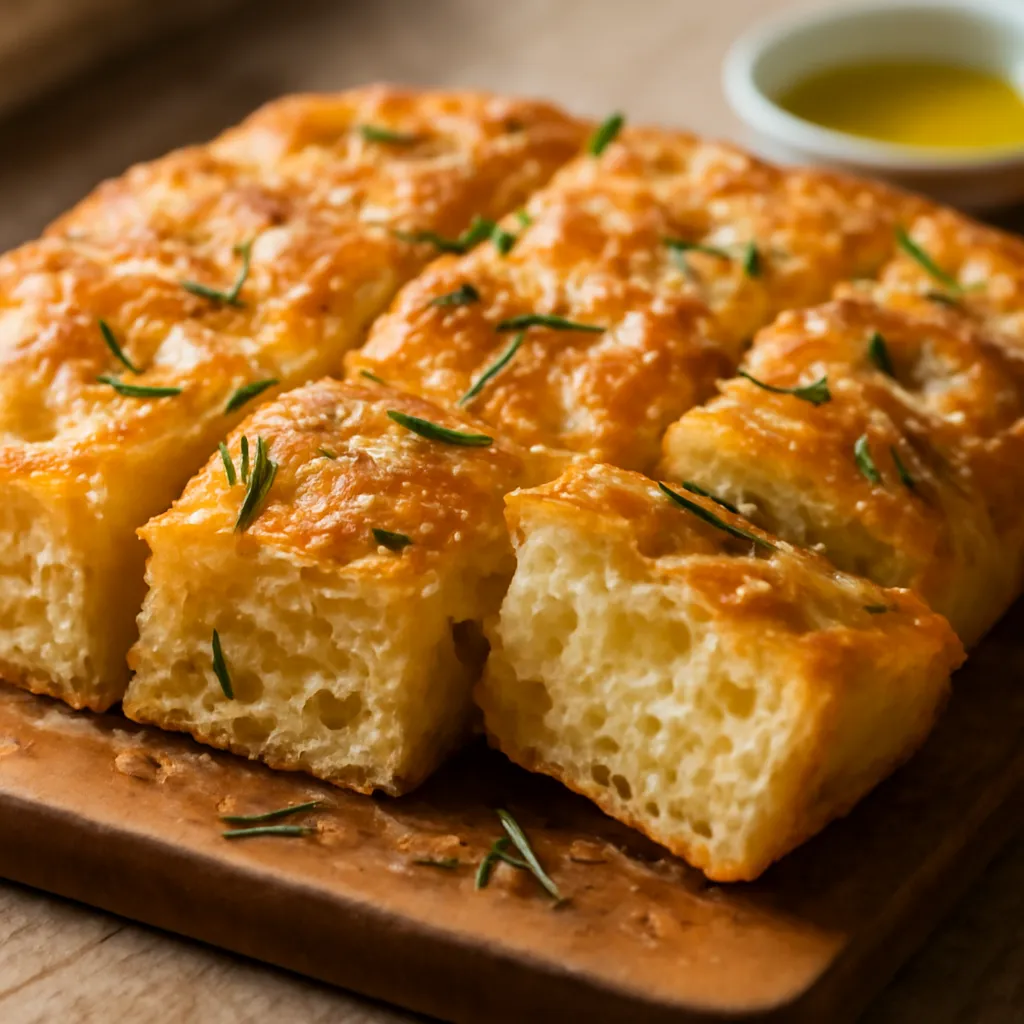
This classic Italian focaccia has a light, open crumb and a deeply golden crust dimpled with fruity olive oil, flaky salt and fresh rosemary. A long, slow rise does most of the work, so the hands-on time is minimal. Serve it warm, torn straight from the tin.
Great focaccia is about patience, not skill. A wet, slack dough and a long rise give you those coveted airy holes, while a generous slick of good olive oil crisps the base and blisters the top. Dimpling the dough with your fingers creates little pools that catch oil, flaky salt and rosemary, so every torn piece tastes properly Italian.
Ingredients
Method
- In a large bowl, whisk together the flour, yeast, sugar and fine sea salt, keeping the yeast and salt on opposite sides as you add them so the salt doesn't knock back the yeast.
- Add the lukewarm water and 2 tablespoons of the olive oil, then mix with a spatula or your hand until you have a rough, very wet and sticky dough. Don't add extra flour, it should look shaggy and loose.
- Cover the bowl and leave somewhere warm for 10 minutes, then do a set of stretch-and-folds: wet one hand, grab the dough from one side, stretch it up and fold it over into the middle, turning the bowl and repeating four times. Cover and repeat this every 10 minutes for three more sets, then leave to rise until doubled and bubbly, about 1 to 1.5 hours.
- Generously oil a 30 x 20cm baking tin with 2 tablespoons of olive oil. Tip the risen dough into the tin and gently coax it towards the corners without deflating it too much. Cover loosely and leave to prove for another 45 minutes to 1 hour, until puffy and jiggly.
- Heat the oven to 220C/200C fan/gas 7. Drizzle the remaining 2 tablespoons of olive oil over the dough, then press your oiled fingertips straight down all over the surface to make deep dimples right to the base of the tin.
- Scatter over the rosemary leaves and tuck a few whole sprigs into the dimples, then sprinkle generously with flaky sea salt. If you like, splash a tablespoon of cold water over the top for extra steam and a crisper crust.
- Bake for 22 to 25 minutes until deep golden brown and crisp at the edges, with the base sounding hollow when tapped.
- Lift the focaccia out of the tin onto a wire rack and drizzle with a final little slick of olive oil while hot. Cool for at least 10 minutes, then tear or cut into squares and serve warm.
Serve it with
- a small dish of good olive oil and aged balsamic for dipping
- antipasti of olives, sun-dried tomatoes and cured meats
- a bowl of hearty minestrone or tomato soup
- soft burrata or mozzarella and ripe tomatoes
- as the bread alongside any Italian pasta supper
Why this works
The very high water content (an 80% hydration dough) creates steam as it bakes, opening up that light, holey crumb, while the pools of olive oil in each dimple essentially shallow-fry the crust to a crisp, golden finish.
Common swaps
- No fresh rosemary? Use fresh thyme, or scatter with dried oregano.
- Press halved cherry tomatoes and thin garlic slices into the dimples for a classic variation.
- Swap 100g of the bread flour for fine semolina (semola) for a nuttier, more rustic crumb.
- No strong bread flour? Plain flour works, though the crumb will be a little denser and less chewy.
Common mistakes to avoid
- Adding extra flour because the dough feels too wet. The stickiness is what gives you the airy holes, so trust it and use oiled or wet hands instead.
- Skimping on the olive oil in the tin. It fries and crisps the base, so a dry tin gives you a pale, soft bottom instead of a golden crust.
- Dimpling too gently. Press your fingers firmly right down to the base, or the dimples puff shut and you lose those signature oil pools.
- Rushing the rises. Under-proved dough bakes up dense and tight rather than light and open.
Storage, freezing & reheating
Storage: Best eaten the day it's baked. Keep any leftovers wrapped at room temperature for up to 2 days; don't refrigerate, as it dries the bread out.
Freezing: Freezes well for up to 1 month. Cool completely, wrap tightly and freeze whole or in portions; defrost at room temperature.
Reheating: Warm in a 180C/160C fan/gas 4 oven for 5 to 8 minutes to revive the crisp crust; avoid the microwave, which turns it chewy.
Allergen notes: contains Gluten. Always check individual product labels.
Estimated nutrition
Per serving, estimated from typical ingredient values — not a substitute for precise dietary calculation.
| Calories | 290 kcal |
|---|---|
| Protein | 7g |
| Carbohydrate | 45g |
| Fat | 9g |