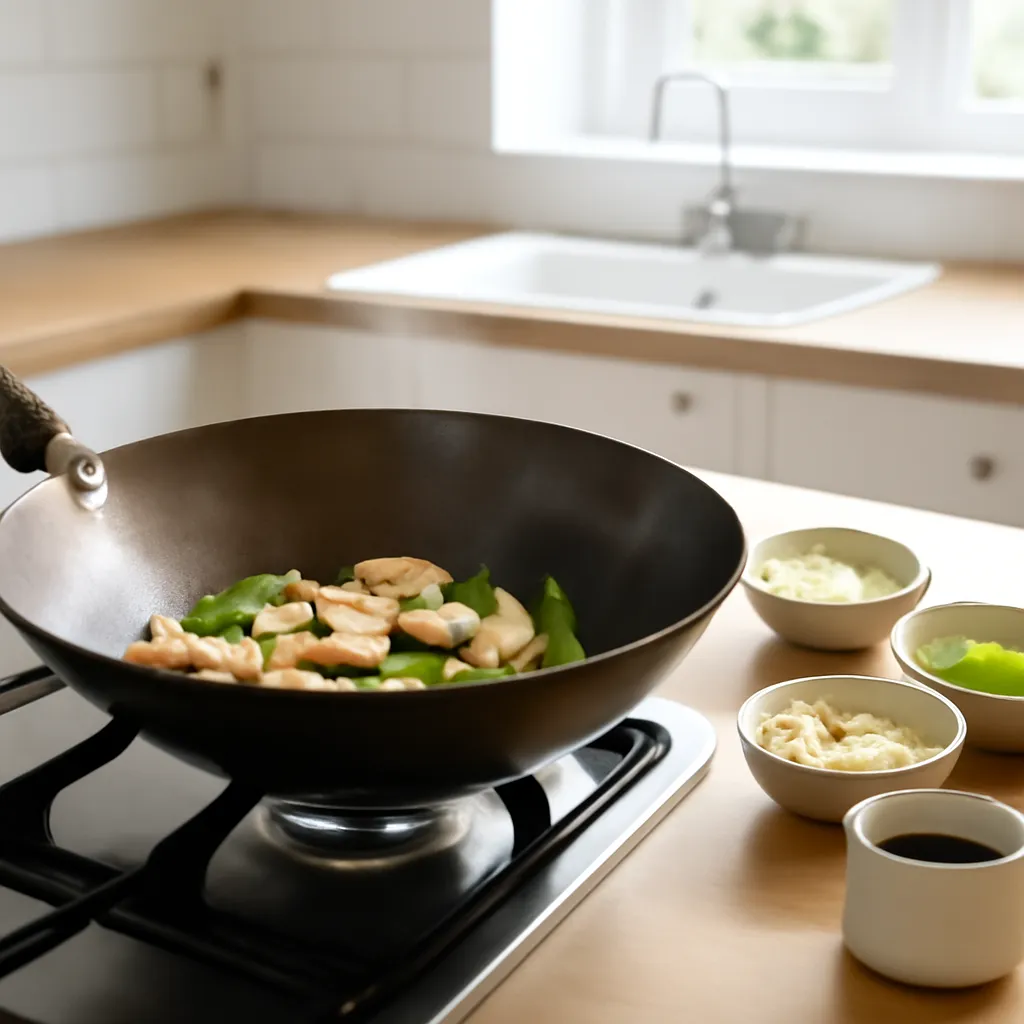
Quick answer: Use a thin carbon steel wok, seasoned to a dark patina. Heat it dry until it just smokes, add 1 tbsp high-smoke-point oil, then cook in small batches of no more than 300g so the pan never drops below roughly 200C. Prep everything before the pan goes on.
A wok is the cheapest upgrade most home kitchens can make, but only if you use it as designed: very hot, briefly, with everything prepped. Get that right and a domestic gas or induction hob will give you stir-fries far closer to a good takeaway than any frying pan will.
Choose the right wok
Buy carbon steel, 1.5-2mm thick, 30-35cm across, with a long wooden handle. Thin steel is the point: it heats in seconds and recovers heat fast when cold food hits it. Cast iron is too slow, non-stick can’t survive the temperatures, and stainless steel is heavy and sticky.
- Gas hob: round-bottomed wok on a wok ring, or a flat-bottomed wok straight on the burner.
- Induction or electric: flat-bottomed only, with at least a 12cm flat base for good contact.
- Avoid non-stick woks: the coating degrades above 260C, below stir-fry temperatures.
Season it once, properly
New woks arrive with a factory lacquer. Scrub it off with a scourer and washing-up liquid, then dry over heat.
- Heat the dry wok until the steel turns straw-gold then blue-grey, tilting to bring the sides up to temperature — about 5-8 minutes.
- Off the heat, wipe in half a teaspoon of a neutral oil with a folded piece of kitchen paper. You want a film so thin it looks dry.
- Return to a medium-high heat until it stops smoking, roughly 3-4 minutes.
- Repeat steps 2-3 three to four times. The surface should end up bronze-brown and faintly glossy.
Afterwards, rinse with hot water and a soft brush, no detergent, then dry on the hob for 30 seconds. Never leave it wet. A mottled, patchy patina is a working wok, not a dirty one.
Get it hot enough
Most home stir-fries fail because the pan is too cool and the food steams in its own juices. Heat the empty, dry wok on your hob’s highest setting for 2-4 minutes before any oil goes in. It is ready when a drop of water flicked in evaporates instantly and skitters, and the first wisps of smoke rise from the centre.
| Oil | Smoke point | Use for |
|---|---|---|
| Refined groundnut | ~230C | Best all-round stir-fry oil |
| Rapeseed / vegetable | ~220C | Cheap, widely available, fine |
| Rice bran | ~230C | Excellent, neutral |
| Sesame (toasted) | ~175C | Finishing only, off the heat |
| Butter / olive oil | 150-190C | Not suitable — burns |
Use 1 tbsp of oil per batch, swirled up the sides. Any more and you shallow-fry.
Prep everything first
A stir-fry cooks in 4-6 minutes flat. There is no time to chop mid-cook. Line up bowls in cooking order:
- Aromatics: garlic, ginger, spring onion whites, finely chopped.
- Protein: sliced against the grain into 3-5mm pieces, velveted if you like — 1 tsp cornflour + 1 tsp soy + 1 tsp water per 250g, 15 minutes.
- Hard veg (carrot, broccoli stem, pepper) and soft veg (beansprouts, pak choi leaves, mangetout) in separate bowls.
- Sauce, pre-mixed in a jug so it hits the pan in one go.
Cook in batches and build wok hei
Wok hei — “breath of the wok” — is the smoky, faintly charred note of a good takeaway. It comes from food searing on very hot metal and sauce vaporising, not from any ingredient.
- Cook no more than 300g at a time in a 30cm wok. Overloading drops the surface temperature sharply and you get grey, watery food.
- Pat protein completely dry; water prevents browning.
- Let it sit 45-60 seconds untouched to take colour, then toss.
- Cook protein first, remove to a plate, then veg, then return everything for the final 30 seconds.
- Add the sauce around the hot rim, not into the middle — it caramelises on the way down.
- Finish off the heat with toasted sesame oil, a splash of Shaoxing wine and fresh herbs.
Serve immediately: a stir-fry left standing goes limp within minutes.
Food safety: Seasoning and stir-frying produce smoke: open a window and run the extractor before you start, and move smoke alarms out of the immediate area if needed. The wok's rim, helper handle and any metal handle get extremely hot — use a dry cloth or oven glove, as a damp one conducts heat and will scald you. Tilting a wok into a gas flame will ignite the oil vapour. If you try it, keep a lid within reach to smother flames, keep face and sleeves clear, and never do it under a low or greasy extractor hood. Never throw water on burning oil and never move a flaming pan. Turn off the heat and cover it. Wet food dropped into very hot oil spits violently. Pat everything dry and add ingredients low to the pan rather than dropping them in.