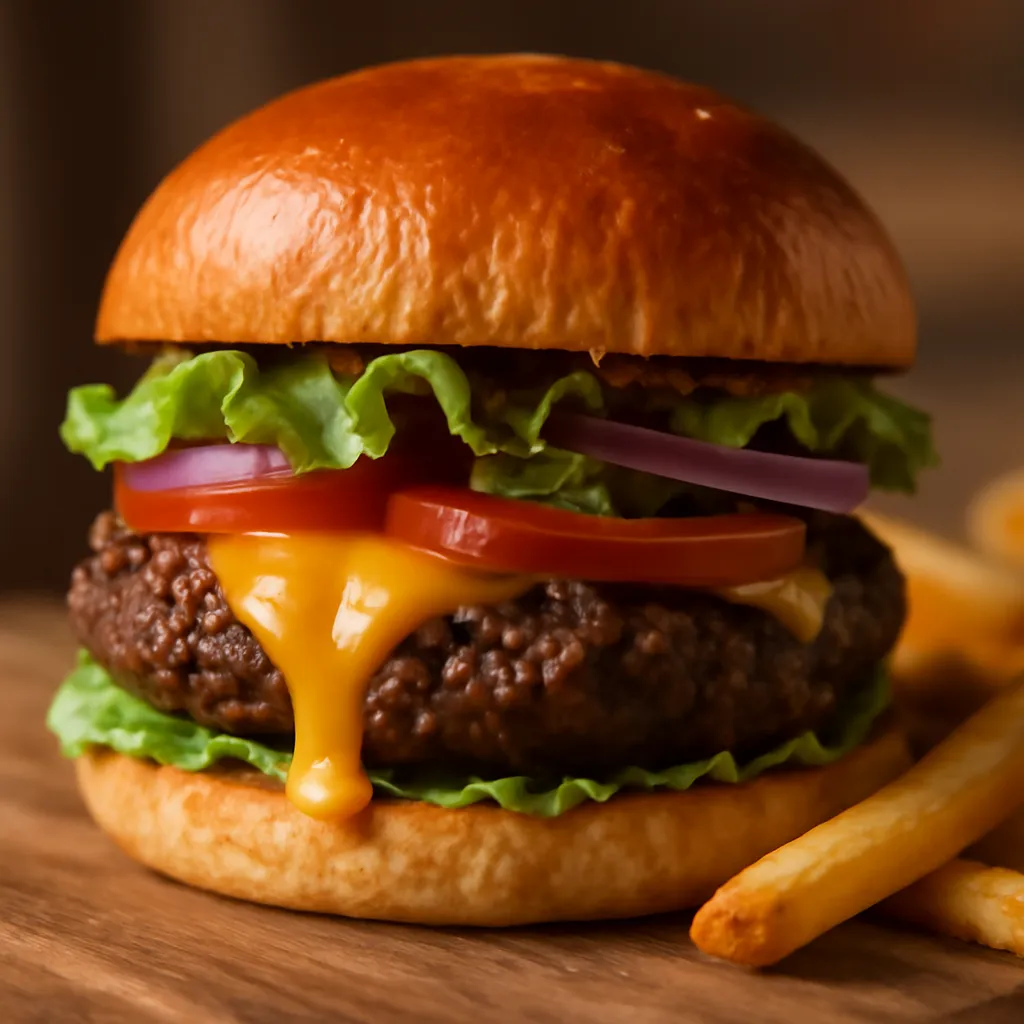
A no-nonsense American classic: coarse beef, seasoned simply, smashed and seared for a deep crust while staying juicy inside. Piled into a toasted bun with melting cheese and crisp trimmings, this is the burger you keep coming back to.
The best beef burger isn’t clever — it’s about good coarse mince, restraint with the seasoning and a fierce heat that builds a savoury crust. Handle the meat as little as possible, salt it only at the last moment, and you’ll get patties that stay loose and juicy. Everything after that is just stacking your favourite trimmings.
Ingredients
Method
- Divide the mince into four loose balls, about 150g each, without kneading or squeezing — the less you work it, the more tender the burger. Chill them while you prep the trimmings.
- Slice the lettuce, tomato and onion, and have the cheese, buns and sauces ready by the hob, as the cooking goes quickly once you start.
- Season each ball generously with salt and pepper only just before cooking. Get a heavy frying pan or ridged griddle very hot and brush the surface with the oil.
- Place the balls in the pan and press each one flat with a spatula into a patty a little wider than your bun. Leave them undisturbed so a dark, savoury crust forms, about 3 minutes.
- Flip once, lay a slice of cheese on each patty and cook for a further 2-3 minutes until the cheese melts and the burgers are cooked through with no pink in the middle and the juices run clear.
- Meanwhile, butter the cut sides of the buns and toast them face down in a second pan or under the grill until golden.
- Spread sauce on the bun bases, add lettuce, then the cheesy patty, followed by tomato, onion and gherkins. Crown with the bun lids and press gently.
- Serve straight away while the cheese is molten and the buns are still warm.
Serve it with
- Skin-on chips or fries
- Crunchy coleslaw
- Sweet potato wedges
- Dill pickle spears
- Cold beer or a milkshake
Why this works
Pressing loosely packed patties onto a screaming-hot surface maximises the Maillard crust that gives a burger its deep, beefy flavour, while the 20% fat keeps the inside juicy. Salting at the very last moment stops the surface proteins tightening into a dense, springy texture.
Common swaps
- Swap Cheddar for Monterey Jack, Swiss or blue cheese
- Use beef mince with 15% fat for a slightly leaner burger
- Replace the burger sauce with barbecue sauce or chipotle mayo
- Add crisp streaky bacon or a fried egg on top
- Use lettuce leaves instead of a bun for a low-carb version
Common mistakes to avoid
- Over-working or compacting the mince, which makes the burgers dense and tough
- Salting the meat too early, drawing out moisture and firming the texture
- Flipping and pressing the patties repeatedly, squeezing out the juices
- Cooking on too low a heat, so the burger steams grey instead of forming a crust
Storage, freezing & reheating
Storage: Best eaten fresh, but cooked patties keep in the fridge for up to 2 days in an airtight container; store the components separately so the buns and salad stay crisp.
Freezing: Freeze raw, shaped patties between sheets of baking paper for up to 3 months. Cook from frozen over a slightly lower heat, or thaw fully in the fridge first.
Reheating: Reheat a cooked patty in a hot pan or medium oven until piping hot throughout; avoid the microwave, which turns the crust soft and rubbery.
Allergen notes: contains Milk, Gluten, Mustard. Always check individual product labels.
Estimated nutrition
Per serving, estimated from typical ingredient values — not a substitute for precise dietary calculation.
| Calories | 620 kcal |
|---|---|
| Protein | 38g |
| Carbohydrate | 34g |
| Fat | 38g |