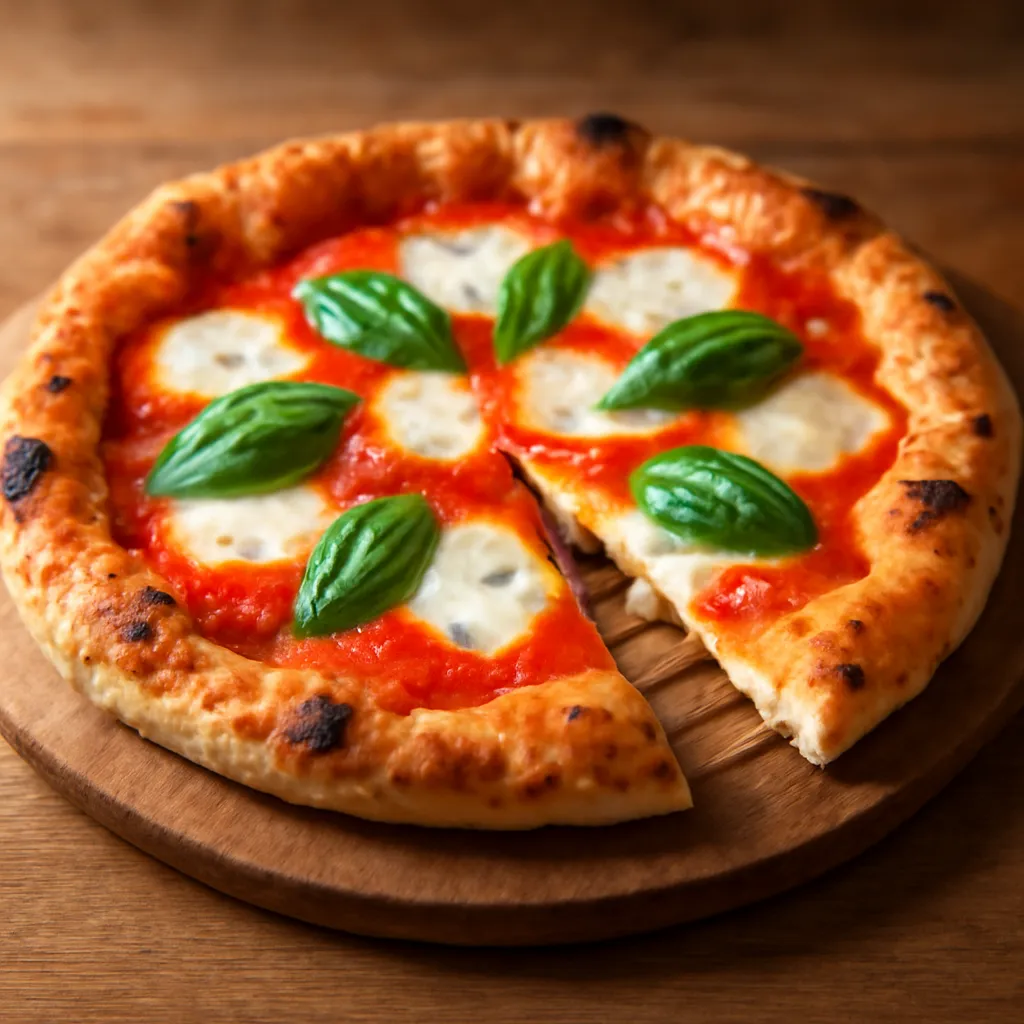
A proper fakeaway Margherita: a puffed, leopard-spotted crust, a bright uncooked tomato sauce and torn mozzarella that pools rather than weeps. The whole trick is heat - a tray or steel preheated for a full 45 minutes at maximum, so the base sets before the toppings can steam it soggy.
Takeaway Margherita wins on texture: a base that crackles at the rim and stays foldable in the middle, under cheese that has just melted rather than fried. Home ovens run 200C cooler than a pizza oven, so you borrow the heat back from metal - a tray or steel preheated hard, then the grill on full to finish the top. Twelve minutes, two pizzas, no soggy middle.
Ingredients
Method
- Mix the flour, yeast and salt in a large bowl, keeping the salt and yeast on opposite sides at first. Pour in the warm water and olive oil and bring together into a shaggy dough, then knead on a lightly oiled surface for 8 minutes until smooth and springy. Cover and leave somewhere warm for 45-60 minutes, until roughly doubled.
- While it rises, make the sauce. Tip the tomatoes into a bowl, discard any hard cores and crush them thoroughly with your hands or a fork - do not blend, or the sauce turns pink and foamy. Grate in the garlic clove, add the salt and the pinch of sugar if needed, and leave it raw. It cooks on the pizza.
- Tear the mozzarella into rough 2cm pieces, spread it on a plate lined with kitchen paper and leave it in the fridge, uncovered, until you need it. This is the single biggest fix for a wet pizza - brine mozzarella can shed several tablespoons of liquid in the oven.
- Put a heavy baking tray upside down, a pizza steel or a baking stone on the top-third shelf and heat the oven to its absolute maximum, usually 250C fan or 270C conventional, for a full 45 minutes. A hot oven is not the same as a hot tray; the metal needs that time to load up.
- Knock the dough back and divide it in two. Working with one piece at a time on a well-floured surface, press from the centre outwards with your fingertips, leaving the outer 2cm untouched - that ring of trapped gas becomes the puffed crust. Stretch to about 26cm, letting the dough hang over your knuckles rather than rolling it flat.
- Slide the base onto a floured board or a sheet of baking paper. Spread 3-4 tablespoons of sauce thinly to within 2cm of the edge, scatter over half the mozzarella and half the grated hard cheese, and drizzle with a little olive oil. Keep the toppings sparse - overloading is what steams a base.
- Shunt the pizza onto the hot tray, paper and all, and bake for 8-10 minutes until the crust is puffed and patched with brown. Switch the grill to high for the last 1-2 minutes to blister the top, watching it constantly at this stage.
- Slide it out, scatter over torn basil and a final trickle of extra virgin olive oil, then let it settle for a minute before cutting so the cheese sets slightly. Repeat with the second dough ball while the first is being eaten - the tray will still be hot enough.
Serve it with
- A peppery rocket and Parmesan salad dressed with lemon
- Garlic and herb dough balls made from a third dough ball
- Chilli oil or dried chilli flakes for scattering
- A cold Italian lager or a glass of Chianti
- Olives and marinated artichokes as a starter
Why this works
Takeaway pizza is a race between the base setting and the toppings releasing water, and the pizzeria wins it with brutal bottom heat. A tray or steel preheated for 45 minutes at maximum does the same job at home, firing the underside in the first 30 seconds so it can never go soggy - while drying the mozzarella in the fridge removes the moisture that would otherwise flood it.
Common swaps
- No time to prove: a chilled pack of fresh pizza dough (about 500g, enough for two) or two shop-bought bases work with the same sauce and cheese
- San Marzano tomatoes are worth seeking out, but any decent tin of Italian whole plum tomatoes crushed by hand beats a jar of pizza sauce
- Swap fior di latte for buffalo mozzarella if you like it milkier - drain it even harder, it holds more water
- For a Marinara, drop the cheese entirely and go with sauce, sliced garlic, oregano and olive oil
- Vegetarians should use a hard Italian-style cheese made with non-animal rennet in place of Parmesan
Common mistakes to avoid
- Not preheating the tray long enough - ten minutes in the oven gives you a pale, bready base no matter how hot the dial reads
- Using wet mozzarella straight from the tub, which floods the sauce and leaves a grey puddle in the middle
- Blending the tomatoes, which aerates the sauce and dulls the fresh flavour that makes a Margherita sing
- Rolling the dough with a pin, crushing out the gas that should become the puffed, chewy crust
Storage, freezing & reheating
Storage: Best eaten straight from the oven. Cooked pizza keeps in the fridge, loosely covered, for up to 2 days. Undivided dough can be left in the fridge overnight - up to 24 hours - and actually tastes better for it; bring back to room temperature for 30 minutes before stretching.
Freezing: Freeze the dough balls, lightly oiled and individually bagged, for up to 3 months. Defrost overnight in the fridge, then leave at room temperature for an hour before shaping. Leftover cooked slices freeze for up to a month, interleaved with baking paper.
Reheating: Never the microwave. Reheat slices in a dry frying pan over a medium heat for 3-4 minutes with a lid on for the last minute - the base re-crisps while the cheese melts. A hot oven at 220C on a preheated tray for 5 minutes does the same job for several slices.
Allergen notes: contains Milk, Gluten. Always check individual product labels.
Estimated nutrition
Per serving, estimated from typical ingredient values — not a substitute for precise dietary calculation.
| Calories | 780 kcal |
|---|---|
| Protein | 34 g |
| Carbohydrate | 97 g |
| Fat | 27 g |