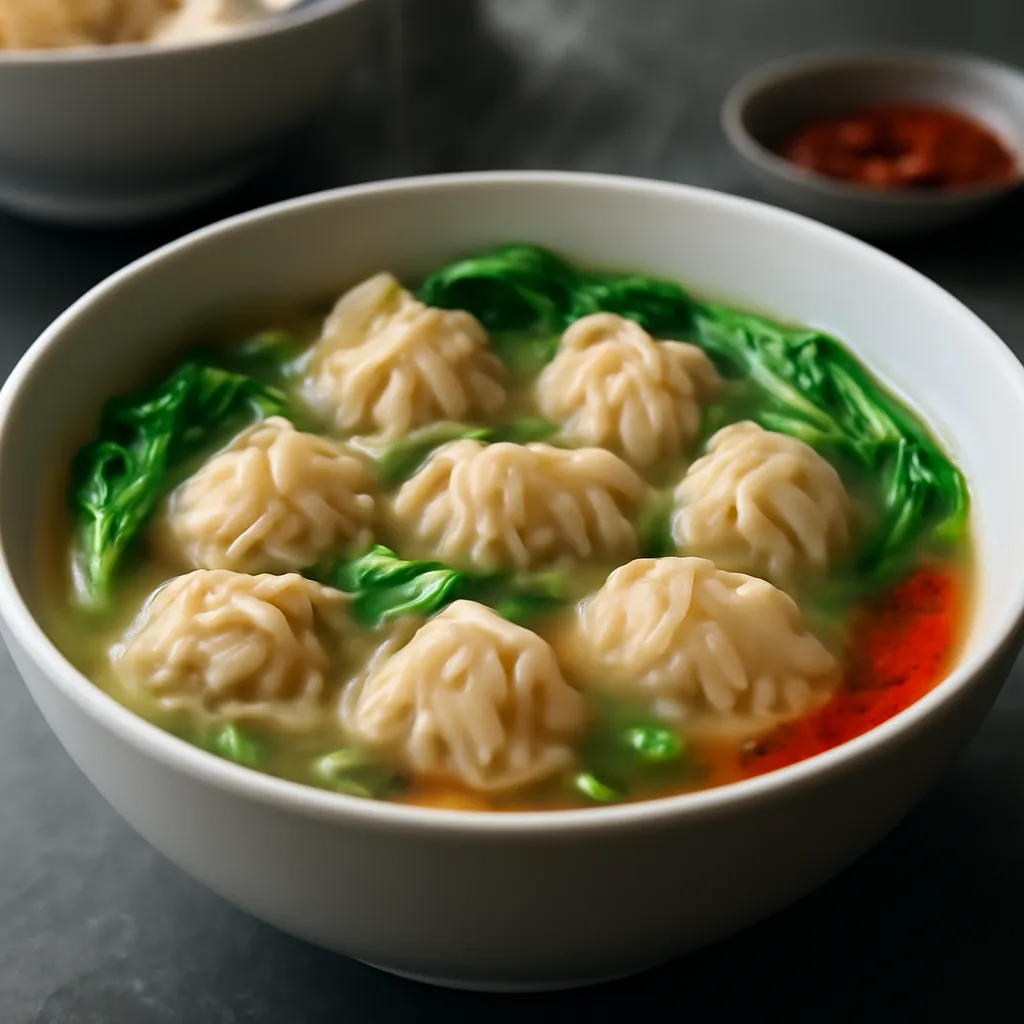
Plump pork and prawn wontons poached in a clean, gingery chicken broth, finished with spring onion and a few drops of sesame oil. The filling is beaten until sticky so it stays juicy and springy rather than crumbly, and the wontons are cooked separately so the broth stays crystal clear. Ready in under an hour, and the raw wontons freeze beautifully.
Takeaway wonton soup lives or dies on two things: a bouncy, juicy filling and a broth you can see through. Both are easy once you know the tricks. You beat the pork in one direction until it turns tacky, and you poach the wontons in a separate pan of water so no starch clouds the soup. Twenty wrappers, fifteen minutes at the hob.
Ingredients
Method
- Make the filling. Put the pork mince in a bowl with the Shaoxing wine, 2 tsp light soy, sesame oil, cornflour, sugar, white pepper, grated ginger and the 2 chopped spring onions. Now the important bit: beat it hard with a wooden spoon or chopsticks, stirring in one direction only, for 3-4 minutes, adding the cold water a tablespoon at a time. It will go from loose and crumbly to sticky and glossy, clinging to the spoon in one mass. Fold in the chopped prawns and chill for 15 minutes.
- Set up a folding station: the bowl of filling, a small dish of water, the wrappers under a damp tea towel so they don't dry out, and a tray dusted lightly with cornflour.
- Fold the wontons. Lay a wrapper on your palm and put a heaped teaspoon of filling in the centre — resist overfilling. Wet two edges with a fingertip, fold into a triangle and press out any trapped air as you seal. Then dab one bottom corner, bring the two bottom corners together around your finger and pinch to make the classic little nurse's-cap shape. Set on the tray and repeat; you want 32-40.
- Build the broth. Bring the chicken stock to a gentle simmer with the 3 ginger slices and 1 tbsp light soy. Let it tick over for 10 minutes, then taste and season with more soy or a pinch of salt and white pepper. Keep it at a bare simmer — you want it clear, not boiling hard.
- At the same time, bring a large, separate pan of unsalted water to a rolling boil. This is the trick to a clean-tasting soup: never cook the wontons in the broth itself.
- Drop the wontons into the boiling water in two batches so they aren't crowded. Stir gently once to stop them sticking. When they float, add a splash of cold water, bring back to the boil and cook another 1-2 minutes. They are ready when the wrappers are translucent and slightly ruffled and the filling is firm, opaque and cooked through with no pink — cut one open to check the first time.
- Drop the pak choi into the simmering broth for the last minute, just until the leaves wilt and the stems are tender-crisp.
- Lift the wontons straight out of the water with a slotted spoon and divide between four warmed bowls, 8-10 per person. Ladle the piping hot broth and greens over the top.
- Finish with the sliced spring onions and a few drops of sesame oil on each bowl. Serve at once, while the wrappers still have their silky bite.
Serve it with
- Crispy seaweed and prawn crackers for a full takeaway starter spread
- Chilli oil or chiu chow chilli oil spooned over at the table
- A splash of black rice vinegar for dipping the wontons
- Salt and pepper chips or char siu as the main event
- Jasmine tea, or a cold lager
Why this works
Beating the pork in one direction with a little cold water draws out the meat's own proteins, so the filling sets into that bouncy, juicy takeaway texture instead of a dry crumb — and the water turns to steam inside the wrapper, basting it as it cooks. Poaching the wontons in a separate pan of plain water keeps the loose starch out of the broth, which is why takeaway wonton soup arrives clear rather than cloudy.
Common swaps
- No Shaoxing wine? Dry sherry is the closest match; dry vermouth or a splash of apple juice with extra soy will also do.
- Prawn-free: use all pork, or swap the prawns for 100 g finely chopped chestnut mushrooms squeezed dry.
- Chicken or turkey thigh mince works in place of pork — add an extra teaspoon of sesame oil, as it is leaner.
- Can't find wonton wrappers? Gyoza wrappers are thicker but usable; trim square if you like. Avoid filo — it disintegrates.
- For a richer takeaway-shop broth, add a splash of oyster sauce and a pinch of MSG or mushroom seasoning powder to the stock.
Common mistakes to avoid
- Overfilling. A heaped teaspoon is plenty — any more and the wrapper splits in the water and you lose the filling to the pan.
- Cooking the wontons in the broth. The flour on the wrappers turns the soup grey and starchy; use a separate pan of water every time.
- Skipping the beating stage. Mince that is simply stirred together stays crumbly and dry, and the filling shrinks away from the wrapper.
- Boiling the broth hard. A rolling boil turns a clear stock murky and drives off the delicate ginger aroma — keep it at a lazy simmer.
Storage, freezing & reheating
Storage: The soup is best eaten straight away, as the wrappers soften in liquid. Store any leftover wontons and broth in separate airtight containers in the fridge for up to 2 days. Uncooked folded wontons will sit on a floured tray in the fridge for a few hours, but freeze them if you want to keep them longer.
Freezing: Freeze uncooked wontons on a lined tray, spaced apart, until solid — about 2 hours — then tip into a freezer bag and keep for up to 3 months. Cook from frozen straight in boiling water, adding 2 minutes to the time. The broth freezes for 3 months too. Don't freeze cooked wontons; the wrappers turn to mush.
Reheating: Reheat the broth in a pan until piping hot, then add cold or freshly poached wontons for the last minute only, so the wrappers stay silky rather than falling apart. Leftover cooked wontons are excellent shallow-fried in a little oil until the edges are crisp and golden and the filling is piping hot, then dipped in chilli oil — better than a soggy microwave.
Allergen notes: contains Gluten, Egg, Crustaceans, Soya, Sesame, Sulphites. Always check individual product labels.
Estimated nutrition
Per serving, estimated from typical ingredient values — not a substitute for precise dietary calculation.
| Calories | 410 kcal |
|---|---|
| Protein | 28 g |
| Carbohydrate | 36 g |
| Fat | 17 g |