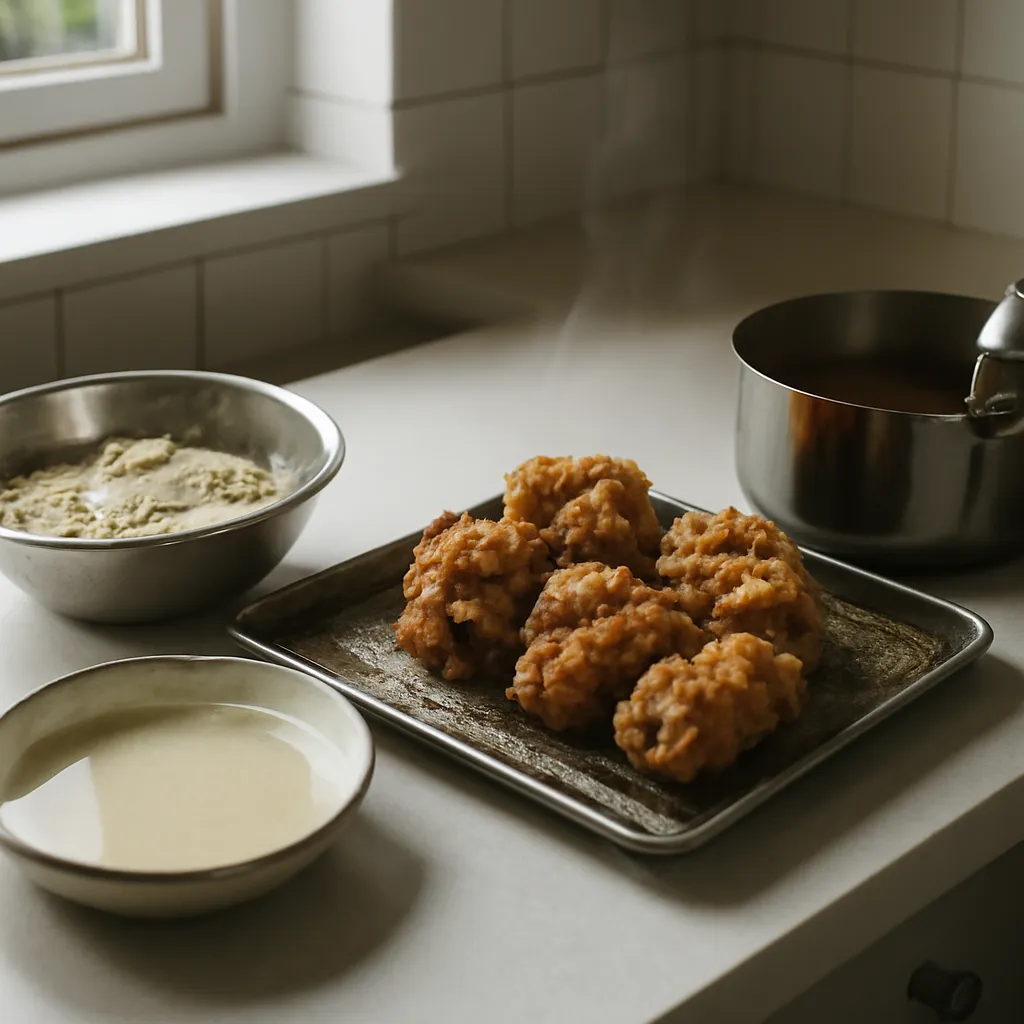
Quick answer: Brine the chicken in buttermilk and salt, then dredge in flour cut with roughly a third cornflour, dampened with a little brine so it goes craggy. Fry at 165C until cooked, rest 5 minutes, then blast at 190C for 60-90 seconds. Sauce at the very last second.
Takeaway chicken is crisp for reasons you can copy exactly: a wet brine that seasons and tenderises, a starch-heavy coating that fries drier and harder than plain flour, deliberate craggy texture, and two trips through the oil at different temperatures. None of it needs a deep-fat fryer — a deep, heavy pan and a probe thermometer will do it.
Start with the brine
Buttermilk does two jobs: its mild acidity loosens the surface proteins so the meat stays juicy, and it is thick enough to cling and glue dry coating to the chicken. Use 300ml buttermilk per 500g chicken with 1 tsp fine salt and whatever you like for flavour — smoked paprika, garlic granules, black pepper, a splash of hot sauce.
- Thighs and small pieces: 2-4 hours, up to overnight.
- Breast, cut into strips or 3cm chunks: 1-2 hours is plenty; longer and the texture goes slightly pasty.
- No buttermilk? 280ml whole milk + 1 tbsp lemon juice, left 10 minutes, behaves almost identically.
Lift pieces out and let the excess run off for a few seconds. Dripping wet gives you gluey coating; bone dry gives you patchy coating.
Get the flour ratio right
Plain flour alone browns fast but softens fast. Cornflour has no gluten and very little protein, so it fries into a thin, glassy, brittle shell that stays crisp far longer. Blend the two.
| Style | Plain flour | Cornflour | Result |
|---|---|---|---|
| Southern-style craggy | 150g | 75g | Thick, shaggy, sturdy crust |
| All-purpose fakeaway | 120g | 80g | Crisp, even, good under sauce |
| Korean-style, sauced | 60g | 140g | Thin, glassy, survives glazing |
Season the dredge properly — 2 tsp salt per 200g flour, plus 2 tsp paprika, 1 tsp garlic granules, 1 tsp onion granules, 1 tsp baking powder. That baking powder is worth adding: it puffs the coating microscopically and increases surface area.
Build a craggy crust
Smooth coating is thin coating. To get the ridged, rubbly surface takeaways have:
- Drizzle 2-3 tbsp of the brine into the dry flour and rub it through with your fingertips until it looks like coarse breadcrumbs.
- Press each piece hard into the flour, then squeeze it in your fist — pressure is what makes the shards stick.
- For a double-dredge, go flour, back into the brine for 2 seconds, then flour again. Twice the shell, twice the crunch.
- Rest the coated chicken 15 minutes on a rack. The flour hydrates and stops sloughing off in the oil.
Fry twice
Use a wide, deep pan no more than one third full of a neutral oil — sunflower, groundnut or rapeseed. Fry in small batches; crowding drops the temperature and gives you greasy, pale chicken.
| Stage | Oil temp | Time | Purpose |
|---|---|---|---|
| First fry | 160-165C | 6-8 min (thighs), 4-5 min (strips) | Cooks through, drives off moisture |
| Rest | — | 5-10 min on a rack | Steam escapes, crust sets |
| Second fry | 190-195C | 60-90 seconds | Colour, blistering, final crunch |
Chicken is safe at 75C in the thickest part. Always drain on a wire rack, never kitchen paper — paper traps steam and softens the bottom instantly.
Keep it crisp once sauced
Sauce is the enemy of crunch, so make it work harder:
- Reduce the glaze until it coats the back of a spoon. Thin, watery sauce soaks straight in.
- Have the sauce hot and ready before the chicken leaves the oil, and toss for no more than 10-15 seconds.
- Toss in a warm bowl, serve immediately; anything sat in sauce for two minutes is a lost cause.
- Holding a batch? Wire rack in a 110C oven, uncovered, up to 30 minutes. Never cover with foil.
Food safety: Never fill a pan more than one third with oil, and lower chicken in away from you with tongs or a spider — wet food dropped into hot oil will spit violently. If oil catches fire, turn off the heat and smother the pan with a metal lid or fire blanket. Never move a burning pan and never throw water on it — the water flashes to steam and blasts burning oil across the room. Cook chicken to 75C in the thickest part, checked with a probe, and keep raw chicken, its brine and anything it touched away from ready-to-eat food. If serving with rice, cool leftover rice within one hour, refrigerate it, use within 24 hours and reheat once until piping hot throughout.