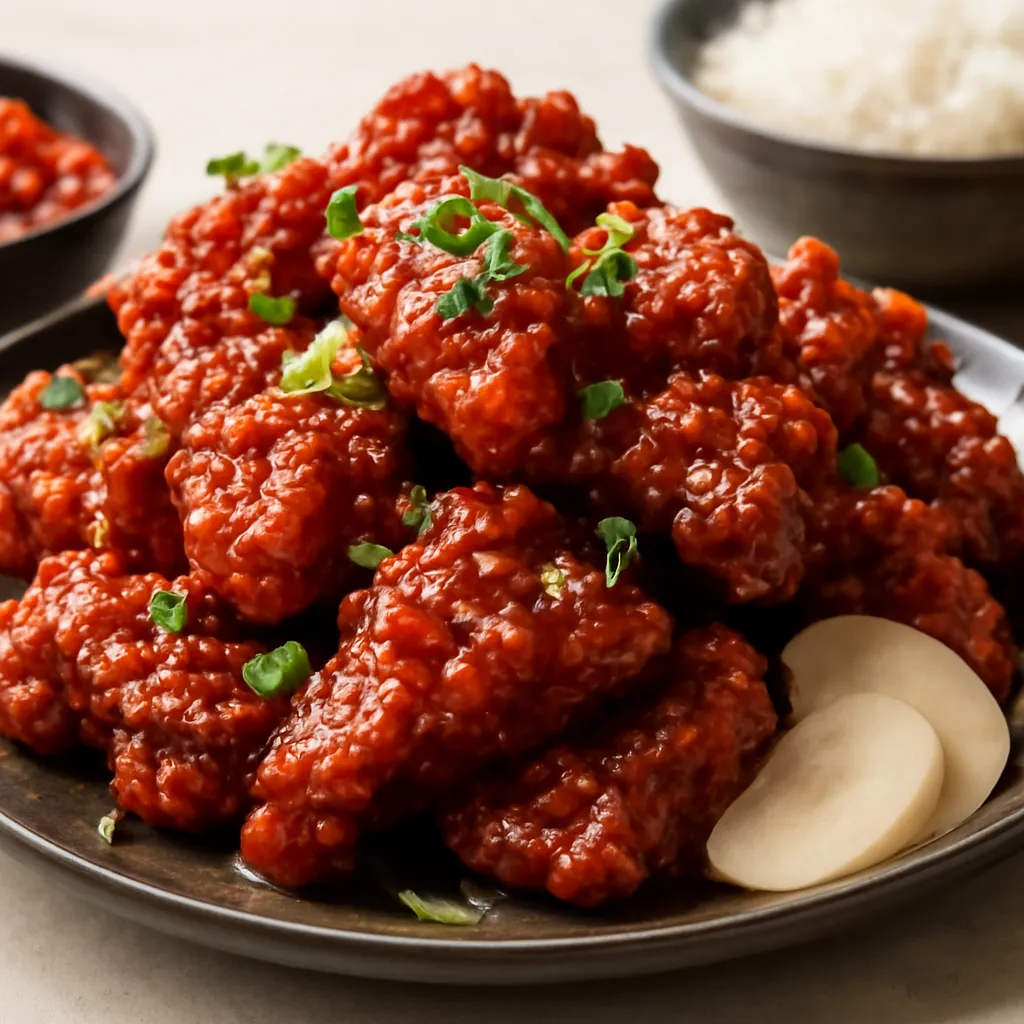
Bite-sized chicken thigh in a bone-dry starch coating, fried twice so the crust turns glassy and stays that way. It is tossed at the last second in a glossy gochujang, garlic and honey glaze that clings without softening the crunch. Serves four with rice and pickles.
Korean fried chicken earns its reputation on texture: a thin, brittle crust that stays crunchy under a sticky, glossy gochujang glaze. The secret is a dry starch coating and two trips through the oil, the second one hot and fast. Twenty minutes of frying at home beats any delivery bag, because nothing steams on the journey.
Ingredients
Method
- Toss the chicken with the rice wine, salt, white pepper and ginger. Leave for 15 minutes while you get everything else ready - this seasons the meat itself, so the crust does not have to do all the work.
- Mix the potato starch and baking powder in a wide bowl. Sprinkle over the cold water and rub it through with your fingers until the starch looks like damp sand with small lumps in it. Those lumps are what fry into the craggy, shatter-crisp bits.
- Drop the chicken into the starch a few pieces at a time and press hard so every surface is thickly coated and completely dry to the touch. Shake off the excess and set the pieces on a wire rack, not touching. Let them sit 5 minutes so the coating hydrates and grips.
- Heat the oil in a large deep pan to 160°C, filling it no more than a third full. If you have no thermometer, a pinch of the starch mix should sizzle steadily and rise within a couple of seconds rather than fizzing violently. Our guide at /guides/how-to-deep-fry-safely-at-home/ covers pan choice and what to do if things get lively.
- Fry in three batches, about a third of the chicken at a time, for 6-7 minutes, turning once, until pale gold and cooked through with no pink in the thickest piece. Lift onto a wire rack set over a tray - never onto kitchen paper, which traps steam and softens the crust. Rest 5 minutes so the surface dries out.
- Bring the oil up to 190°C. Give each batch a second fry of just 1-2 minutes, until deep amber and audibly crisp, then back onto the rack. Do not crowd the pan; too much chicken drops the oil temperature and you lose the crunch.
- While the second fry goes on, simmer the gochujang, honey, soy, rice vinegar and garlic in a wide pan over a medium heat for 2-3 minutes, until it thickens to a glossy, syrupy glaze that coats the back of a spoon. Take it off the heat and stir in the sesame oil.
- Tip the hot chicken into the warm glaze and toss fast - 20 seconds, no more - so every piece is lacquered but the crust has no time to go soft. Scatter with sesame seeds and spring onions and serve straight away, piping hot.
Serve it with
- Steamed short-grain rice
- Shop-bought or homemade kimchi
- Quick-pickled mooli or cucumber in rice vinegar and sugar
- Cold lager or a fizzy soda, takeaway-style
- A sharp shredded cabbage slaw with a little sesame oil
Why this works
The double fry is the whole trick: the low first fry cooks the chicken and drives moisture out of the coating, and the short blast at 190°C sets that dried starch into a glassy shell. Because potato starch fries harder and less absorbently than flour, the glaze sits on top of the crust instead of soaking into it.
Common swaps
- No gochujang? Use 2 tbsp sriracha plus 1 tsp sweet smoked paprika and a pinch of sugar for a similar sweet-savoury heat.
- Cornflour instead of potato starch - still very good, just a slightly finer, less shard-like crust.
- Chicken wings work beautifully: fry 8-9 minutes first, then 2 minutes hot.
- For a soy-garlic version, drop the gochujang and use 4 tbsp soy, 3 tbsp honey, 6 cloves garlic and 1 tbsp rice vinegar.
- Firm tofu or cauliflower florets take the same coating; fry once at 180°C for 5-6 minutes.
Common mistakes to avoid
- Wet coating. If the chicken looks damp or pasty going into the oil, the crust will be soggy - press the starch on until the surface is dry and powdery.
- Frying it all at once. Crowding drops the oil below 160°C and the chicken absorbs fat instead of crisping. Three batches, always.
- Draining on kitchen paper. Steam gets trapped underneath and softens the base. Use a wire rack over a tray.
- Glazing too early or too hot. Boiling the chicken in the sauce turns the crust to mush - toss off the heat, right before serving.
Storage, freezing & reheating
Storage: Best eaten within minutes. Leftovers keep, covered, in the fridge for up to 2 days, though the crust will soften.
Freezing: Freeze after the first fry only, unglazed, on a tray then bagged, for up to 2 months. Cook from frozen with a 3-4 minute second fry at 190°C, then glaze.
Reheating: Skip the microwave. Spread on a rack and reheat in a hot oven at 200°C for 8-10 minutes, or in an air fryer at 190°C for 5-6 minutes, until piping hot and crisp again, then re-toss in a little fresh warmed glaze.
Allergen notes: contains Gluten, Soya, Sesame, Sulphites. Always check individual product labels.
Estimated nutrition
Per serving, estimated from typical ingredient values — not a substitute for precise dietary calculation.
| Calories | 640 kcal |
|---|---|
| Protein | 44 g |
| Carbohydrate | 45 g |
| Fat | 31 g |