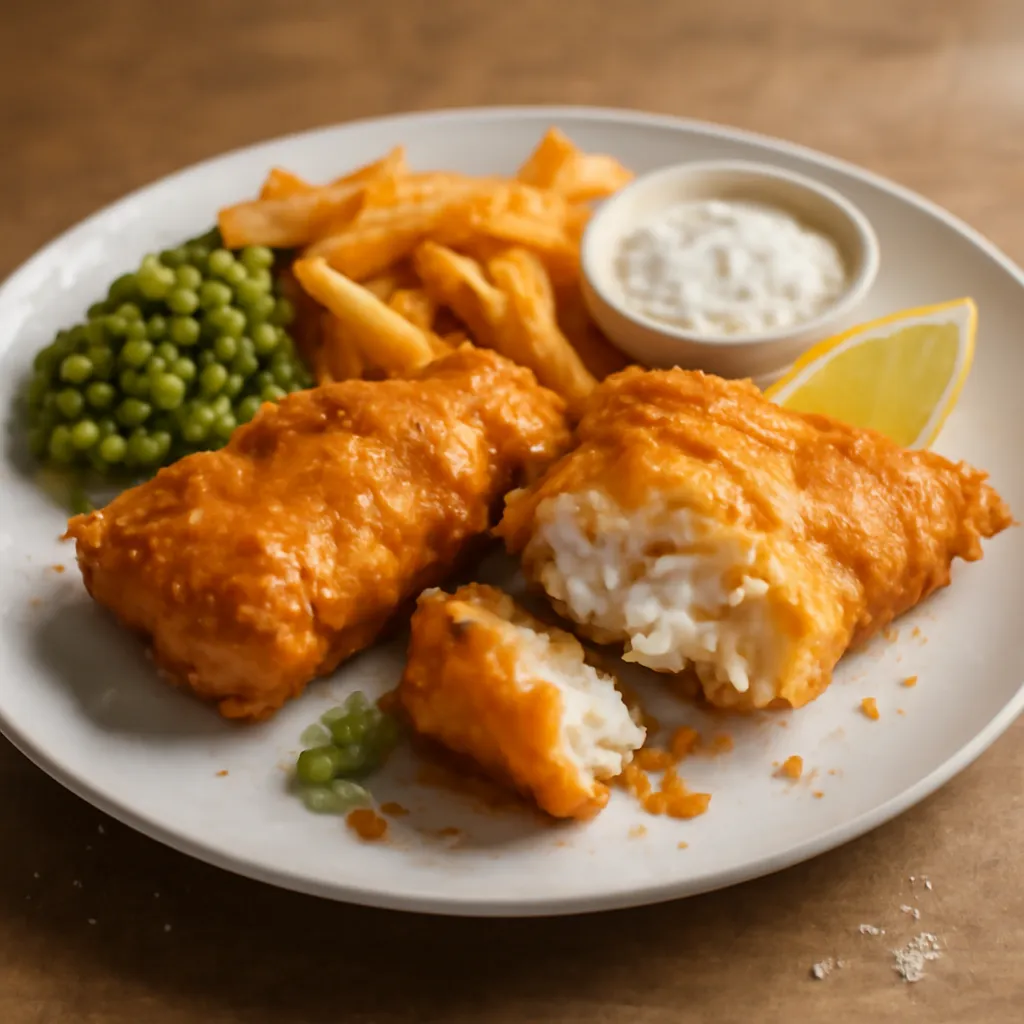
Cold fizzy beer, plain flour and a spoonful of cornflour make a batter that fries up blistered, golden and genuinely crunchy rather than soft and bready. The fish steams inside its shell so it stays juicy and flakes cleanly. It is the closest thing to a Friday-night chippy supper you can make at home in half an hour.
Chip-shop batter is not complicated, but it is fussy about temperature. Everything cold, oil properly hot, and the fish goes in the second the batter is mixed. Get that right and you get the sound you are after when the fork goes in: a dry, glassy crackle, then thick flakes of steaming white fish underneath. No sogginess, no greasy aftertaste.
Ingredients
Method
- Pat the fish very dry with kitchen paper, season all over with the 1 tsp fine salt and leave uncovered on a plate in the fridge while you set up. This firms the flesh and draws off surface water, which is the difference between batter that clings and batter that slides off in the pan.
- Pour the oil into a large, deep, heavy pan so it comes no more than a third of the way up the sides. Heat to 180°C. If you have no thermometer, drop in a 2cm cube of bread: it should turn deep golden in about 40 seconds and fizz busily from the moment it hits. Never leave the pan unattended, and keep a lid nearby to smother the pan if needed — see our guide at /guides/how-to-deep-fry-safely-at-home/.
- Set a wire rack over a baking tray next to the hob and heat the oven to 100°C so you can hold the first batch while the second fries.
- Only once the oil is at temperature, whisk the 150g plain flour, cornflour, baking powder, ½ tsp salt and white pepper in a bowl. Pour in the cold beer and whisk just until it comes together into a batter about the thickness of double cream. Lumps are fine. Do not beat it smooth and do not let it stand — you want the fizz still in it.
- Put the 3 tbsp dusting flour on a plate. Blot the fish dry once more, roll each fillet in the flour and tap off all the excess, then dunk it into the batter and lift it out letting the surplus stream back into the bowl.
- Lower two fillets into the oil away from you, holding each one in the oil for a couple of seconds before letting go so the batter sets and it does not stick to the pan base. Fry for 6-7 minutes, turning once, until the coating is deep golden and blistered and the fish is cooked through with no translucent patches — it should flake easily when nudged with a fork at the thickest point.
- Lift onto the wire rack, never onto kitchen paper, and scatter with flaky salt straight away. Draining on a rack lets steam escape from underneath so the base stays as crisp as the top. Slide the tray into the low oven.
- Bring the oil back up to 180°C before the next batch — it will have dropped by 20-30°C — then fry the remaining two fillets the same way. Serve immediately with lemon wedges and malt vinegar, while it is piping hot.
Serve it with
- Thick-cut triple-cooked chips
- Mushy peas with a knob of butter
- Proper tartare sauce, heavy on the capers and gherkins
- Curry sauce for dipping
- Bread and butter, for a chip butty
Why this works
The chip-shop trick is fizz plus cold plus speed: ice-cold beer keeps the gluten lazy and the carbon dioxide expands the instant it hits 180°C oil, blowing the coating into a thin, blistered honeycomb rather than a bready jacket. Cornflour and baking powder push it further, and mixing the batter only when the oil is already hot means none of that lift is wasted sitting in the bowl. More on the ratios in /guides/how-to-make-perfect-batter/.
Common swaps
- Sparkling water or alcohol-free lager instead of beer — same fizz, same crunch, no alcohol.
- Pollock, coley or hake are cheaper and fry beautifully; keep to thick pieces so they do not overcook.
- Frozen fillets work well: defrost fully in the fridge, then press dry between kitchen paper — surface water is the enemy.
- No cornflour? Use rice flour, or all plain flour with an extra ½ tsp baking powder, though the crunch is softer.
- Air fryer or oven cannot do this batter. If that is your only option, use a breadcrumb coating instead.
Common mistakes to avoid
- Making the batter early. It goes flat within about 20 minutes and fries up dense and pale. Mix it last.
- Oil too cool. Below about 165°C the batter absorbs oil before it sets and you get a greasy, limp coating. Use a thermometer and let it recover between batches.
- Overcrowding the pan. Two fillets at a time, maximum, or the temperature crashes and everything steams.
- Draining on kitchen paper. The trapped steam softens the underside within a minute — always use a wire rack.
Storage, freezing & reheating
Storage: Best eaten within minutes. Leftovers keep, loosely covered, in the fridge for up to 2 days, but accept that the batter will have softened.
Freezing: Not recommended once battered — the coating turns spongy on thawing.
Reheating: Do not microwave. Reheat on a wire rack set over a tray in an oven at 200°C for 8-10 minutes, or in an air fryer at 190°C for 5-6 minutes, until the batter crisps up again and the fish is piping hot right through.
Allergen notes: contains Gluten, Fish, Sulphites. Always check individual product labels.
Estimated nutrition
Per serving, estimated from typical ingredient values — not a substitute for precise dietary calculation.
| Calories | 610 kcal |
|---|---|
| Protein | 38g |
| Carbohydrate | 48g |
| Fat | 29g |