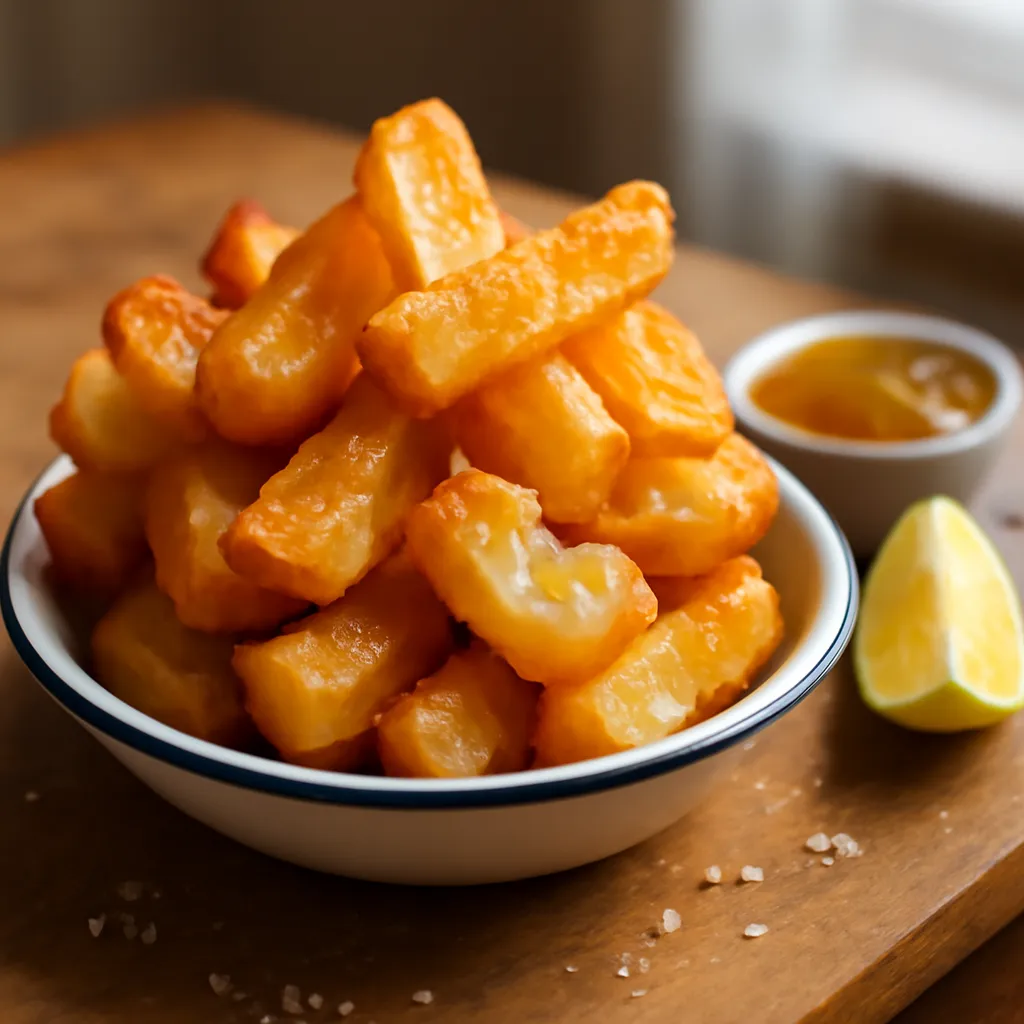
Floury potatoes are simmered until their edges go ragged, chilled bone-dry, then fried twice — once low to cook them through, once fierce to glass the outside. The result is a chip with an audible crack and a cloud-soft centre, far better than anything you can queue for.
Proper chip-shop chips are two textures at once: a brittle, blistered shell and a middle like mashed potato. You get there by cooking the potato three times — a salted simmer to rough up the surface, a cold rest to drive off moisture, then two fries at different temperatures. It takes patience rather than skill, and the payoff is enormous.
Ingredients
Method
- Peel the potatoes and cut them into chunky chips about 1.5 cm thick — bigger than skinny fries, smaller than wedges. Keep them even so they cook at the same rate. Rinse under cold running water for a minute or two until the water runs clear, which washes off loose starch that would otherwise catch and burn.
- Put the chips in a large pan, cover with cold water by 5 cm, add the salt and the vinegar if using, and bring to a gentle simmer. Cook for 10-14 minutes, until the outsides look ragged and a chip breaks if you press it firmly against the side of the pan. Do not stir — lift and turn with a slotted spoon if you must. Undercooking here is the single most common mistake: those fluffed-up edges become the crust.
- Drain very gently in a colander and leave to steam-dry for 5 minutes. Spread the chips in a single layer on a wire rack set over a tray and chill, uncovered, for at least 30 minutes (an hour is better, and 20 minutes in the freezer works if you're pushed). They should feel dry and slightly chalky to the touch. Surface water is the enemy of crisp.
- Heat the oil to 130°C in a deep, heavy pan filled no more than a third of the way up, or in a deep-fat fryer. Without a thermometer, a cube of bread should sizzle lazily and take about 60 seconds to gild. Our guide to deep-frying safely at home (/guides/how-to-deep-fry-safely-at-home/) covers pan choice and what to do if things go wrong.
- Fry the chips in three or four batches, never more than a large handful at a time, for 6-8 minutes each. They should stay pale blond and turn slightly translucent, with a dry, papery skin forming — no colour at all. Lift onto a clean wire rack over a tray to drain; kitchen paper traps steam and softens them.
- Chill the fried chips again on the rack for at least 30 minutes, or up to a day in the fridge. This second cooling sets the shell and lets it dry, which is exactly what makes the final fry explode into crispness rather than just brown.
- Bring the oil up to 190°C. It should shimmer and move visibly, and a chip dropped in should fizz hard and rise straight to the surface. Fry in batches again for 3-4 minutes until deep gold and blistered — listen for the noise dying down, which tells you the moisture has gone.
- Drain on the rack for 20 seconds, tip into a warm bowl, scatter generously with flaky sea salt and the malt vinegar powder or white pepper, and toss hard so every chip is coated. Serve immediately, piled high — these wait for no one.
Serve it with
- Beer-battered halloumi or a battered veggie sausage for a full fakeaway
- Curry sauce, warmed and glossy, for dipping
- Mushy peas with a grind of black pepper
- Garlic mayonnaise or a sharp tartare sauce
- Malt vinegar and plenty of salt, straight from the bottle
Why this works
The chip-shop secret isn't the fryer, it's the two cold rests: chilling drives moisture out of the potato's rough, simmered surface so the low fry can set a dry starch skin, and the final blast at 190°C turns that skin to glass instead of wasting its energy boiling off water. Cooking through and crisping are two different jobs, and doing them at two different temperatures is what buys you the crack.
Common swaps
- No thermometer? Use a deep-fat fryer with a dial, or test with a chip: it should barely bubble at 130°C and fizz vigorously at 190°C.
- Swap sunflower for rapeseed oil — it takes the heat well and is cheap enough to use in quantity.
- Chip-shop salt and vinegar seasoning does the same job as malt vinegar powder and is easier to find.
- For a lighter version, do the simmer and chill, then roast at 220°C in 4 tbsp oil for 35-40 minutes, turning once. Not the same crack, but very good.
- Add 1 tsp smoked paprika and ½ tsp garlic granules to the finishing salt for a dirty-fries base.
Common mistakes to avoid
- Pulling the chips out of the simmering water too early. If the edges are still smooth and sharp, there is nothing there to crisp — you want them on the verge of collapse.
- Skipping or shortening the chilling stages. Warm, damp chips steam in the oil and come out limp and greasy every time.
- Overloading the pan. Too many chips drop the oil temperature by 30°C or more, and the chips absorb oil instead of sealing. Fry small batches and let the oil recover between them.
- Draining on kitchen paper or in a covered dish. Trapped steam softens the shell within a minute — always use a wire rack and season the moment they come out.
Storage, freezing & reheating
Storage: Best eaten straight away. Blanched chips (after the first fry and cooling) keep, uncovered on a rack or in a loosely covered container, for up to 24 hours in the fridge — which makes this an excellent make-ahead for a fakeaway night.
Freezing: Freeze after the first fry and cooling: spread the chips on a lined tray, freeze solid, then bag for up to 3 months. Fry from frozen at 190°C for 4-5 minutes, in small batches, as frozen chips cool the oil fast.
Reheating: Never microwave them. Reheat leftovers in a hot oven at 220°C on a wire rack over a tray for 6-8 minutes, or in an air fryer at 200°C for 4-5 minutes, then salt again — a fresh hit of salt brings back the just-fried taste.
Estimated nutrition
Per serving, estimated from typical ingredient values — not a substitute for precise dietary calculation.
| Calories | 480 kcal |
|---|---|
| Protein | 7 g |
| Carbohydrate | 62 g |
| Fat | 22 g |