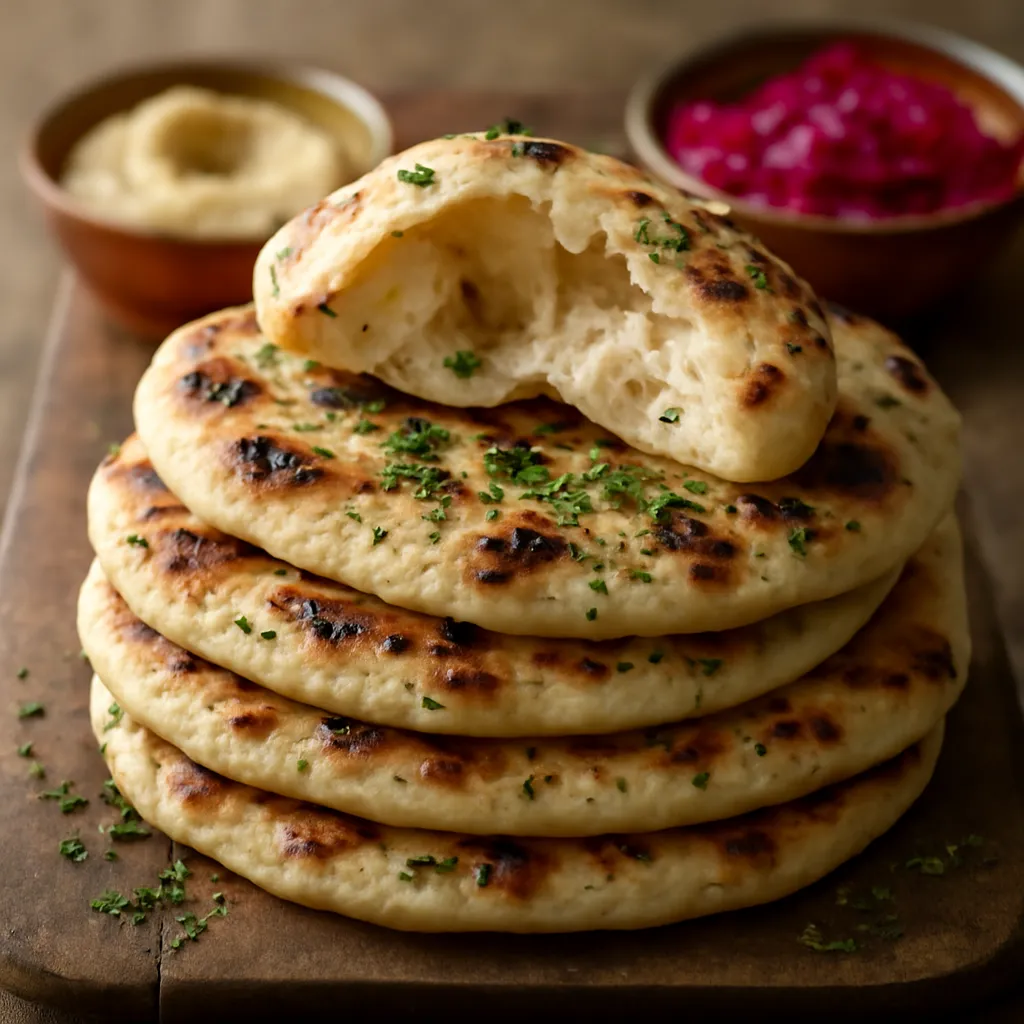
A no-yeast yoghurt dough that goes from bowl to table in under half an hour, cooked in a screaming-hot dry frying pan until it puffs and blisters. Brushed with garlic-coriander butter and stacked under a tea towel, they stay pillowy for hours. This is the bread that makes a home kebab or mezze feel like the real thing.
The bread is what separates a decent home kebab from a proper one. Takeaway flatbreads are soft, chewy and freckled with char, never dry or cracker-thin. You get exactly that from a yoghurt dough and a bone-dry pan run hotter than feels sensible. No yeast, no proving, no bread machine, and the whole batch is done in the time it takes to warm the fillings.
Ingredients
Method
- Whisk the flour, baking powder, fine salt and sugar together in a large bowl so the raising agent is evenly spread — patches of baking powder give patchy puff.
- Add the yoghurt and olive oil and bring it together with a cutlery knife, then your hands, until you have a shaggy dough with no dry flour left. If it refuses to come together, add water a teaspoon at a time.
- Tip onto a lightly floured worktop and knead for 2-3 minutes, just until smooth and springy. This is not a bread dough — over-kneading makes it tough and hard to roll. Cover with the upturned bowl and rest for 10 minutes while you make the butter.
- Melt the butter in a small pan with the crushed garlic over a low heat for 1-2 minutes until it smells sweet and nutty, not browned. Take it off the heat and stir in the chopped coriander.
- Divide the dough into 6 equal pieces and roll each into a ball. On a floured surface, roll one out to a rough oval about 20cm long and 3-4mm thick. Keep the rest covered so they don't skin over.
- Put a heavy frying pan or cast-iron griddle over a high heat with no oil at all and leave it for a good 3-4 minutes until a flick of water evaporates instantly. Dry and very hot is the whole game.
- Lay in a flatbread and cook for 60-90 seconds until the underside is freckled with dark spots and the top has ballooned. Flip and give it another 45-60 seconds. Press any stubborn flat areas gently with a folded tea towel to encourage the puff.
- Brush the hot bread generously with the garlic butter, scatter with nigella seeds, sumac and flaky salt, then stack on a plate under a clean tea towel. The trapped steam is what keeps them soft.
- Repeat with the rest, rolling the next while the last one cooks. Wipe the pan with kitchen paper between breads if flour starts to catch and smoke. Serve warm, straight from the stack.
Serve it with
- Chicken or halloumi shish with pickled red cabbage and chilli sauce
- Hummus, muhammara and a slick of good olive oil for scooping
- A big fattoush or tomato and sumac salad
- Falafel with tahini sauce and shredded lettuce
- Baba ganoush and garlic yoghurt as part of a mezze spread
Why this works
Takeaway flatbreads are cooked in a fierce oven, and the dry pan is the home equivalent: the surface hits well over 200°C, so the water in the dough flashes to steam faster than it can escape and blows the bread into a balloon. Yoghurt does the work of a long prove, its acid reacting with the baking powder for lift while the fat keeps the crumb tender. Stacking them under a tea towel is the non-negotiable last step — that steam softens the crust from crisp to pillowy.
Common swaps
- No yoghurt? Use 200ml milk soured with 1 tbsp lemon juice, plus an extra 20g flour to compensate.
- Dairy-free: coconut or soya yoghurt works in the dough, and olive oil replaces the butter for brushing.
- Swap 100g of the plain flour for wholemeal or spelt for a nuttier, more rustic bread — add a splash more yoghurt as it drinks more liquid.
- No nigella seeds: sesame seeds or a heavy scatter of za'atar (contains sesame) give the same finish.
- Self-raising flour works — just leave out the baking powder and use 1 tsp instead of 2.
Common mistakes to avoid
- Oiling the pan. Fat fries the surface and stops the bread puffing — the pan must be completely dry.
- Cooking at medium heat. Too cool and the water escapes slowly instead of flashing to steam, so you get a dense, pale, biscuity bread.
- Rolling too thin. Under 3mm there isn't enough moisture in the dough to inflate; aim for the thickness of a pound coin.
- Leaving them uncovered on a rack. Flatbreads go leathery within minutes in open air — stack and cover the moment they leave the pan.
Storage, freezing & reheating
Storage: Best within a couple of hours of cooking. Once cool, seal in a food bag and keep at room temperature for up to 2 days; don't refrigerate, as the fridge turns them stale and rubbery.
Freezing: Freeze well for up to 3 months. Cool completely, interleave with baking paper, then bag and seal. Defrost at room temperature for 30 minutes or go straight from frozen into a hot pan.
Reheating: Sprinkle or brush lightly with water, then 20-30 seconds a side in a hot dry pan — the water turns to steam and revives the softness. A toaster on a low setting works for a crisper edge. Avoid the microwave unless you wrap them in a damp tea towel, or they'll toughen as they cool.
Allergen notes: contains Gluten, Milk. Always check individual product labels.
Estimated nutrition
Per serving, estimated from typical ingredient values — not a substitute for precise dietary calculation.
| Calories | 290 kcal |
|---|---|
| Protein | 8g |
| Carbohydrate | 41g |
| Fat | 10g |