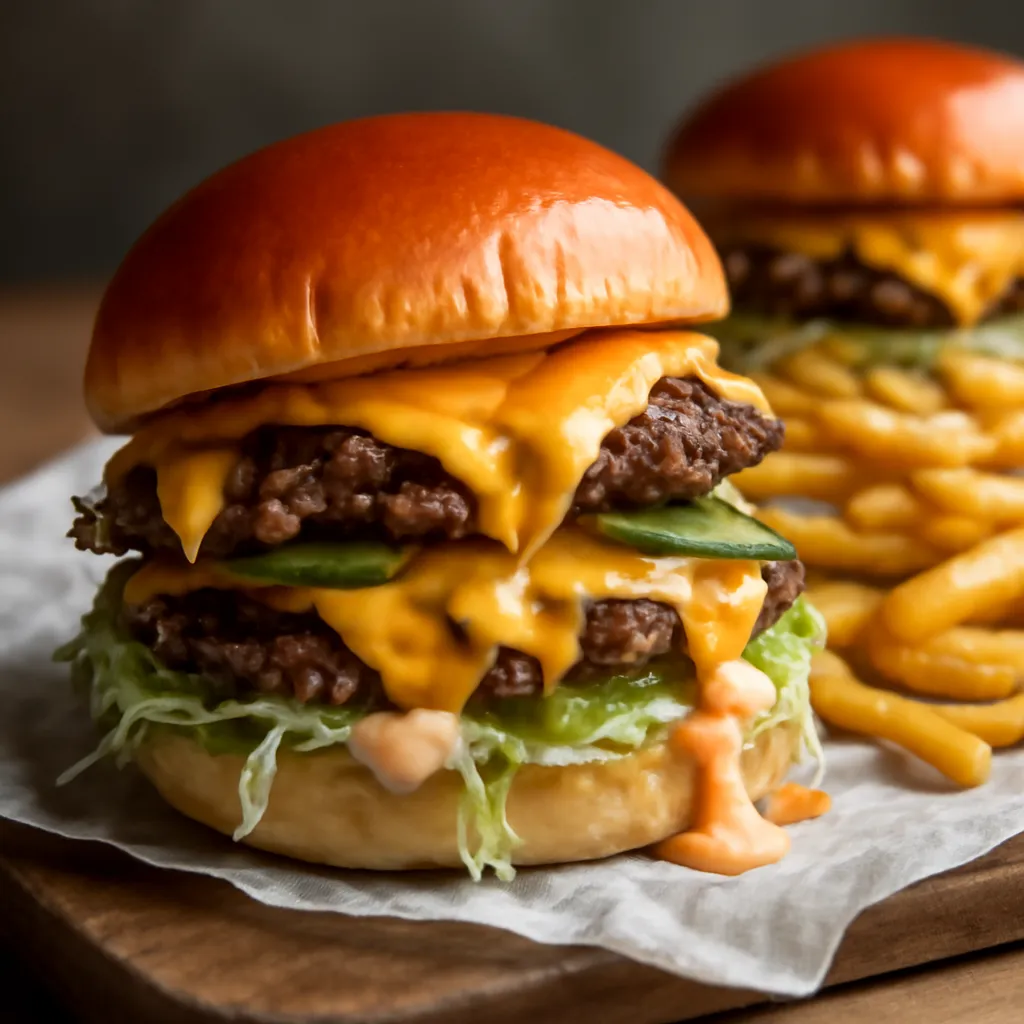
Loose balls of chilled mince smashed hard onto a screaming-hot pan give you the browned, lacy crust that makes takeaway burgers so moreish. Cheese melts straight onto the patty, then everything stacks into a buttered, toasted bun with a tangy pink burger sauce. Fifteen minutes prep, eight minutes cooking, four burgers.
A smash burger is not a thick pub patty. It is thin, ragged and browned right to the lacy edges, which is exactly where the flavour lives. The whole thing hangs on two moves: cold, loosely packed beef and a pan hot enough to sear on contact. Do those and you get a burger that genuinely beats the drive-through, in under ten minutes.
Ingredients
Method
- Make the sauce first: stir the mayonnaise, ketchup, American mustard, chopped gherkins and brine, smoked paprika and garlic granules together in a small bowl. Taste and add a little more brine if you want it sharper, then chill until needed.
- Divide the mince into 8 equal portions, about 75g each, and roll each one into a loose ball with the lightest touch you can manage. Do not compact them and do not season them yet. Put the balls on a plate and return them to the fridge.
- Butter the cut sides of the buns. Toast them cut-side down in a dry frying pan over a medium heat for 1 to 2 minutes until golden, then set aside on the plates. Build the base of each: sauce, shredded lettuce, gherkins.
- Put a heavy frying pan or flat cast-iron pan over your highest heat for a good 4 to 5 minutes. It needs to be properly hot, not warm. Add the oil and swirl to a thin film; it should shimmer and look almost like it is about to smoke.
- Working two at a time, drop the cold beef balls into the pan with plenty of space between them. Immediately smash each one flat with a stiff fish slice or a burger press, using a second spatula or a pan lid to push down hard, until the patty is about 12cm across and thinner than you think it should be. Hold the pressure for 10 seconds.
- Season the tops with salt and pepper and leave the patties completely alone for 2 minutes, until the edges are dark brown and lacy and the raw pink has crept up more than halfway. Scrape underneath firmly with the spatula edge so the crust lifts with the patty rather than sticking to the pan, then flip.
- Scatter a little of the thin onion onto each patty, lay a slice of cheese on top and cook for a further 45 to 60 seconds, until the cheese has slumped and the beef is cooked through with no pink in the middle. Stack one patty on top of another straight in the pan so the cheese glues them, then lift onto a waiting bun base.
- Wipe the pan out with kitchen paper, add a fresh film of oil, get it screaming again and repeat with the remaining beef. Cap with the bun lids and eat while the cheese is still molten.
Serve it with
- Skin-on chips or fries with plenty of salt
- Crisp onion rings
- A sharp, undressed leaf salad to cut the richness
- Extra burger sauce for dipping
- Ice-cold cola or a hoppy lager
Why this works
The crust is a Maillard reaction, and it only happens where cold beef meets very hot metal with maximum contact. Smashing straight from the fridge, once and hard, spreads the fat and protein into a thin lace that browns in seconds, while pressing a patty that has already begun to cook just squeezes out the juices.
Common swaps
- No American-style cheese slices: use mild Cheddar, but grate it so it melts fast.
- American mustard is easy in supermarkets, but a mild English mustard thinned with a pinch of sugar works in the sauce.
- Brioche buns can be swapped for soft white baps; skip anything crusty or sourdough, which fights the patty.
- For a leaner burger, use 5% mince with 1 tbsp melted beef dripping worked in loosely, or the crust will not form.
- No burger press: a wide fish slice pressed with a heavy pan base does the job perfectly.
Common mistakes to avoid
- Using mince straight from a warm kitchen. Room-temperature beef smears and sticks rather than searing; keep it cold right up to the pan.
- Kneading or compacting the balls. Overworked mince turns dense and bouncy, and the lacy edges never form.
- Pressing the patty again after the first smash, or flipping too early. Both squeeze out the fat that is building your crust.
- Crowding the pan. Four patties at once drops the heat and the beef steams grey instead of browning.
Storage, freezing & reheating
Storage: Best eaten the moment they are built. Cooked patties keep in an airtight container in the fridge for up to 2 days; store buns, sauce and salad separately. The burger sauce keeps for 5 days chilled.
Freezing: Freeze the raw balls, spaced on a lined tray until solid, then bagged for up to 3 months. Cook from frozen is not advised; defrost fully in the fridge overnight, then smash as usual. Cooked patties can also be frozen for up to 2 months.
Reheating: Reheat cooked patties in a dry, hot frying pan for about 1 minute a side, adding the cheese for the last 30 seconds, until piping hot. Skip the microwave, which turns the crust soft and greasy. Always toast the buns fresh.
Allergen notes: contains Milk, Gluten, Egg, Mustard, Sulphites. Always check individual product labels.
Estimated nutrition
Per serving, estimated from typical ingredient values — not a substitute for precise dietary calculation.
| Calories | 820 kcal |
|---|---|
| Protein | 45 g |
| Carbohydrate | 38 g |
| Fat | 54 g |