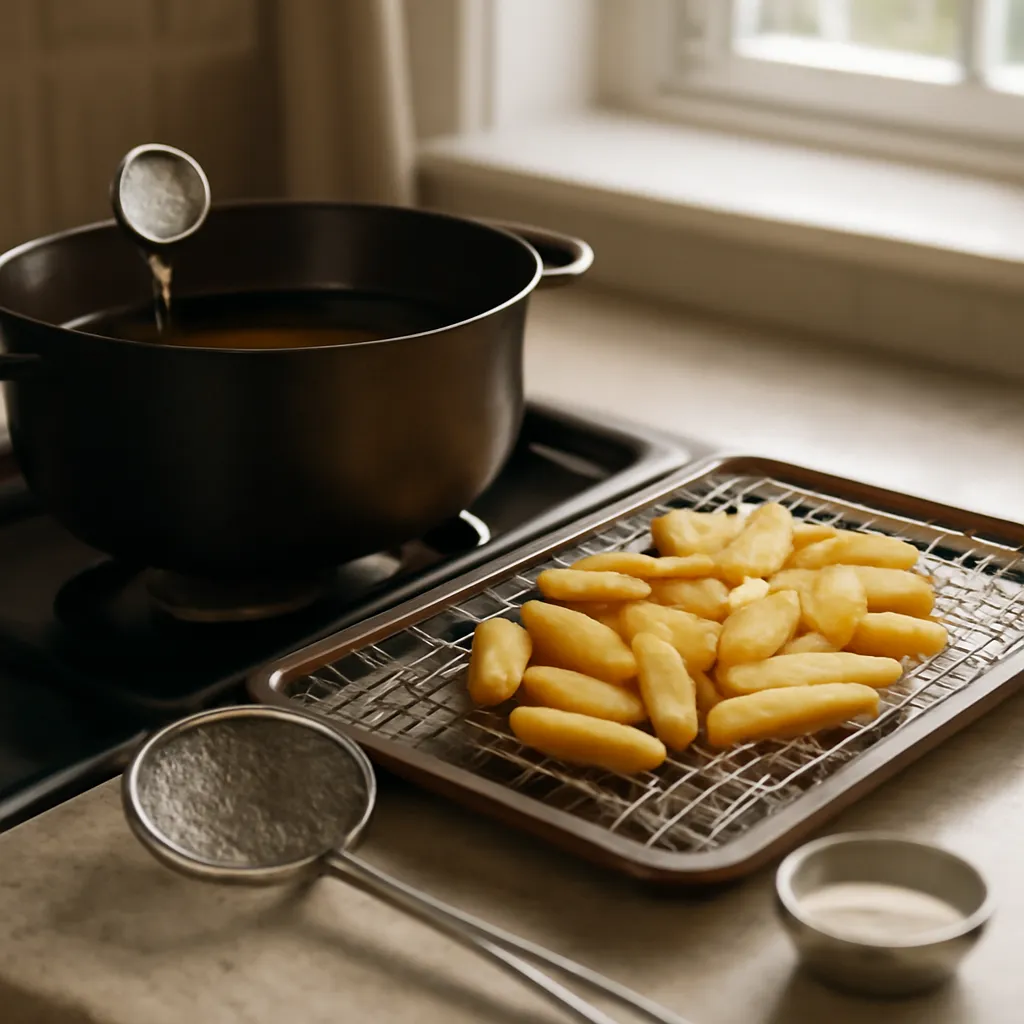
Quick answer: Use a heavy pan filled no more than one third with a neutral high-smoke-point oil, about 5-8cm deep. Heat to 170-190°C, fry in small batches so the oil never drops far below temperature, and drain on a wire rack. If oil smokes, turn off the heat; never add water.
Deep-frying at home comes down to controlling two things: how deep the oil is and how hot it is. Get those right and you will out-crisp most takeaways with nothing more than a heavy pan, a thermometer and a little patience.
Choose the pan and the oil
Use a heavy-based casserole or deep saucepan, at least 20cm wide and 12cm deep. Thick bases hold temperature when cold food hits the oil; thin pans swing wildly. Avoid round-bottomed woks on a domestic hob — they are unstable.
Pick a neutral oil with a high smoke point: sunflower, rapeseed, vegetable or groundnut oil (all around 225°C). Extra virgin olive oil smokes near 190°C and butter far lower, so neither is suitable.
- Fill the pan no more than one third full — roughly 5-8cm of oil, which is about 1.5-2 litres in a 24cm pan.
- Leave at least 8cm of empty pan above the oil line. That headroom absorbs the violent bubbling when damp food goes in, which is what causes most kitchen fires.
- Set the pan on a back ring, handle turned inwards, with nothing flammable nearby.
Get the temperature right
Heat on medium, not full blast — rushing overshoots and scorches the oil. A digital probe or clip-on frying thermometer is the single best £10 you can spend.
| What you are frying | Oil temperature | Rough timing |
|---|---|---|
| Chips, first fry | 140-150°C | 6-8 min, soft not coloured |
| Chips, second fry | 185°C | 2-3 min, golden |
| Battered fish | 175-180°C | 6-8 min |
| Breaded chicken strips | 175°C | 4-5 min |
| Bone-in chicken pieces | 160-165°C | 12-15 min, to 75°C in the centre |
| Spring rolls, samosas, pakoras | 170-175°C | 3-4 min |
| Doughnuts | 170°C | about 2 min per side |
No thermometer? Drop in a 2cm cube of white bread. Golden in 60 seconds means roughly 170-180°C; browning in 30 seconds means it is too hot, and over 90 seconds means it is too cool, so food will drink oil rather than crisp.
Never overcrowd the pan
Every batch drops the oil temperature by 10-20°C. Too much food at once and it never recovers, so the crust stays pale and greasy.
- Cover no more than half the oil surface at a time.
- Pat food thoroughly dry; surface water spits and can boil over.
- Lower pieces in away from you with tongs or a spider, never dropped.
- Nudge the heat up just before adding food, back down once it is in.
- Let the oil climb back to temperature (1-2 minutes) between batches.
Draining and holding
Drain on a wire rack set over a tray, not on kitchen paper — paper traps steam and softens the base. Salt or season immediately while the surface is still hot and slightly oily so it sticks. Keep finished batches crisp in the oven at 90-100°C for up to 20 minutes.
If the oil overheats or catches fire
- Wisps of blue smoke mean the oil is past its limit. Turn off the heat, slide the pan off the ring and let it cool for 10 minutes before reheating.
- If it ignites: turn off the heat if you can reach it safely, then smother with a fire blanket or a close-fitting lid and leave it for at least 30 minutes.
- If it is not out within seconds, leave the room, close the door and call 999.
Cooling, straining and reusing oil
Let the oil cool completely — 2-3 hours — before moving the pan. Strain through muslin into a clean jar, label it with what you fried, and keep it cool and dark.
Expect 3-4 more uses; fish or heavily spiced food, fewer. Bin it once it darkens, turns syrupy, foams at the edges, smells rancid or starts smoking below 180°C. Never pour oil down the sink — it sets solid in the drains. Seal it in a plastic bottle for general waste, or take it to a household recycling centre.
Food safety: Never throw water on burning oil — it flashes to steam instantly and sprays flaming oil across the kitchen. Smother with a fire blanket or lid instead. Never carry or move a pan of burning or smoking oil, even to the sink or outside; the movement spreads the fire and the pan is far too hot to hold safely. Keep children and pets out of the kitchen while frying, turn pan handles inwards, and never leave hot oil unattended on the hob for even a minute. Fry food straight from the fridge only after patting it completely dry; ice crystals and surface water cause the oil to erupt and boil over.