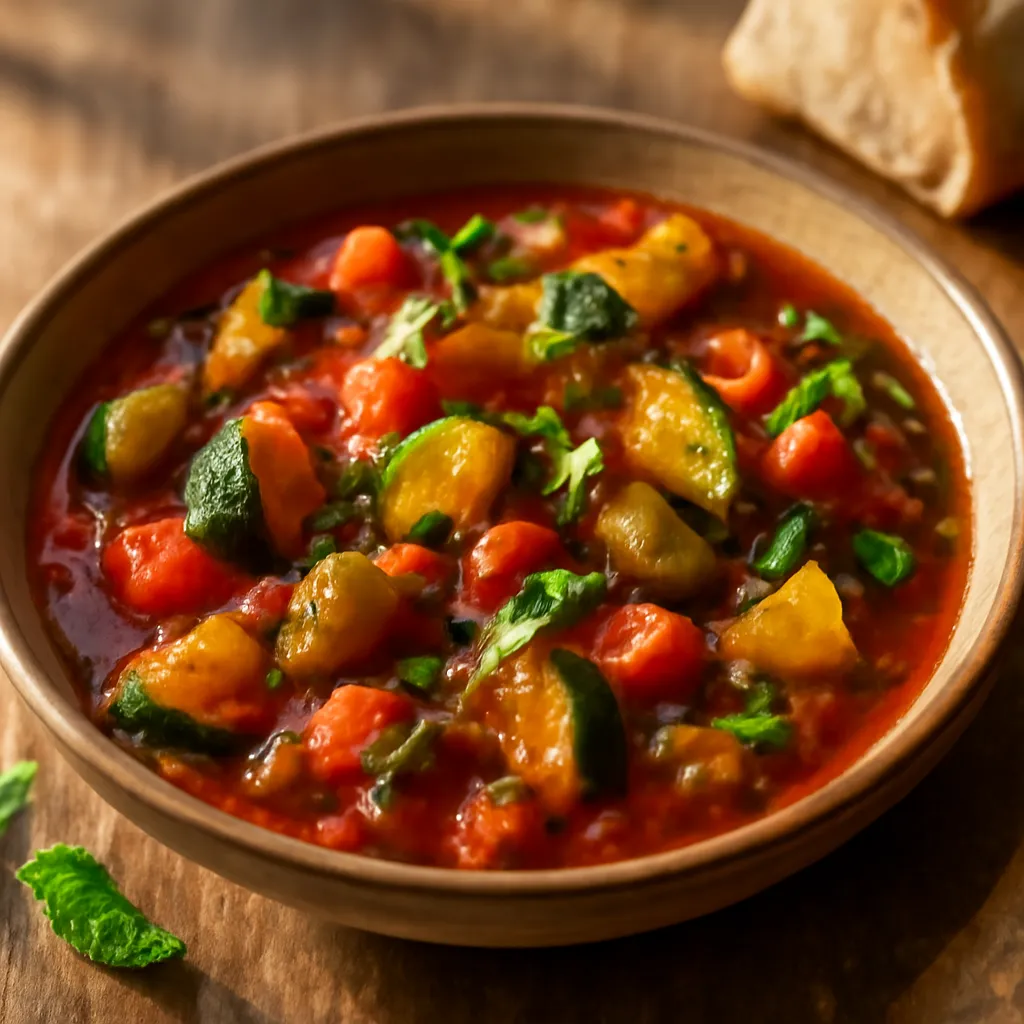
This is ratatouille done the traditional way, cooking the aubergine, courgette and peppers apart so none turn to mush and every mouthful tastes of itself. A slow-simmered tomato base ties it together into a glossy, herb-scented stew that eats brilliantly hot or at room temperature.
Ratatouille lives or dies on patience. Rush every vegetable into one pan and you get grey, watery slop; cook them separately so each caramelises and holds its shape, then bring them together in a rich tomato base, and you get something glossy and layered. It takes a little more time, but the difference is night and day.
Ingredients
Method
- Toss the aubergine cubes with a good pinch of salt and leave in a colander for 10 minutes, then pat dry. This firms them up and stops them drinking too much oil.
- Heat 2 tbsp olive oil in a wide frying pan over medium-high heat. Fry the aubergine until deeply golden on most sides, about 6-8 minutes, then tip onto a plate. Don't crowd the pan or it will steam.
- Add another 1 tbsp oil and fry the courgettes until golden at the edges but still holding their shape, 4-5 minutes; add to the aubergine. Fry the peppers in a little more oil until softened and lightly charred, 5 minutes, and set aside with the rest.
- Turn the heat to medium, add the last 2 tbsp oil and the onion, and cook gently for 8-10 minutes until soft and sweet. Add the garlic and cook for 1 minute more until fragrant.
- Stir in the tomato purée and cook for a minute, then add the chopped tomatoes, herbes de Provence and bay leaf. Simmer for 8-10 minutes until thick and jammy, breaking up the tomatoes with your spoon.
- Fold the cooked aubergine, courgette and peppers back into the tomato base. Add a splash of water if it looks tight, cover and simmer gently for 10 minutes so the flavours marry.
- Uncover, stir through the red wine vinegar and taste for salt and pepper. Fish out the bay leaf, scatter with torn basil and a final drizzle of olive oil, and serve warm or at room temperature.
Serve it with
- Crusty baguette or sourdough to mop the juices
- A soft fried or poached egg on top
- Buttery new potatoes or steamed rice
- Grilled fish or lamb for meat-eaters
- A sharp green salad with mustard vinaigrette
Why this works
Cooking each vegetable separately lets it caramelise and keep its texture, so the finished stew is layered rather than a uniform mush. A splash of vinegar at the end lifts the sweetness and sharpens every flavour.
Common swaps
- No herbes de Provence? Use a mix of dried thyme and oregano, or fresh thyme sprigs.
- Swap one courgette for a small aubergine or a handful of mushrooms.
- Fresh tomatoes out of season taste dull; a tin of good plum tomatoes is better.
- Add a pinch of saffron or smoked paprika to the tomato base for a different accent.
Common mistakes to avoid
- Cooking everything in one pan at once, which steams the vegetables into a watery mush.
- Skimping on the oil or heat, so the aubergine goes soggy instead of golden.
- Overcooking the courgettes until they collapse; pull them off while still holding shape.
- Forgetting to season and add acid at the end, leaving it flat and overly sweet.
Storage, freezing & reheating
Storage: Cool and keep covered in the fridge for up to 4 days; the flavour actually improves overnight.
Freezing: Freezes well for up to 3 months. Cool fully, portion into tubs and freeze; defrost overnight in the fridge before reheating.
Reheating: Reheat gently in a pan over low-medium heat, adding a splash of water if needed, until piping hot. It's also excellent cold.
Estimated nutrition
Per serving, estimated from typical ingredient values — not a substitute for precise dietary calculation.
| Calories | 245 kcal |
|---|---|
| Protein | 4 g |
| Carbohydrate | 18 g |
| Fat | 17 g |