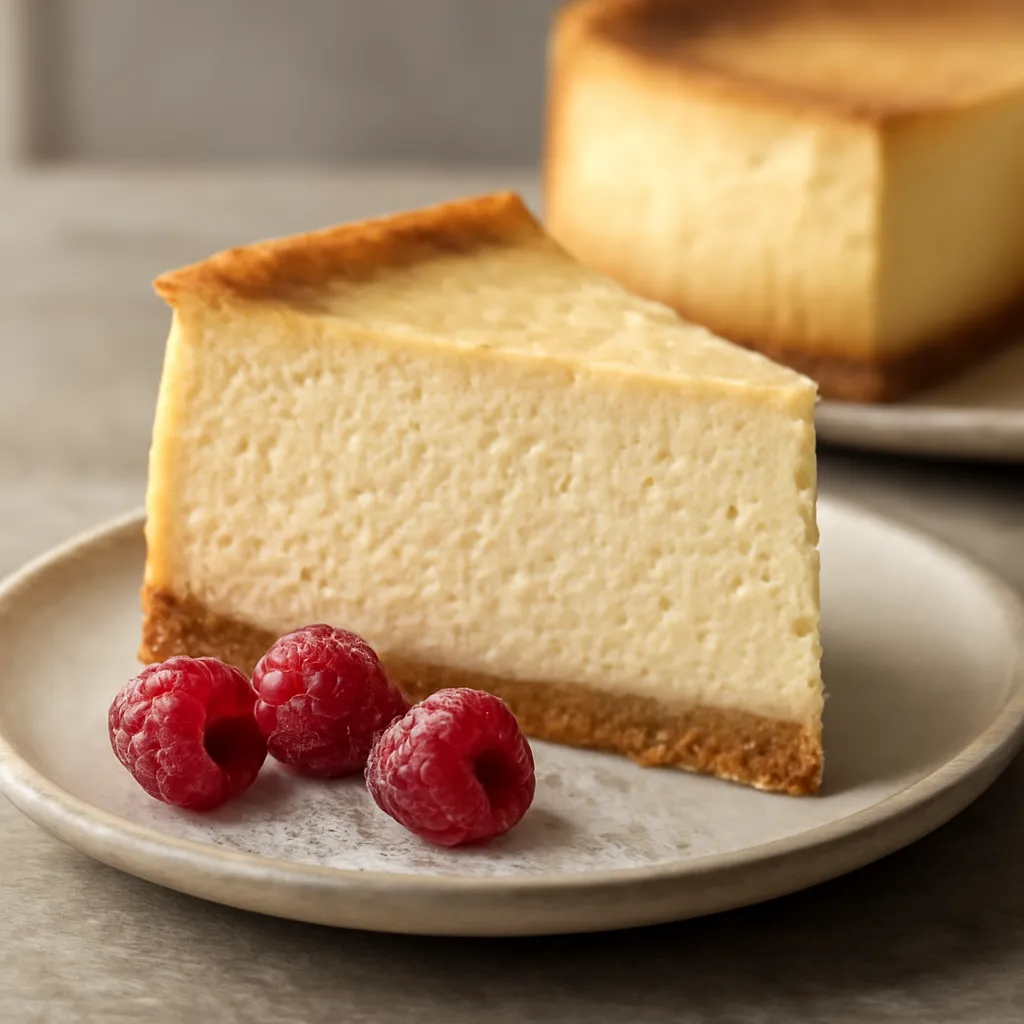
This is the classic American baked cheesecake: thick, rich and impossibly smooth over a crisp buttery biscuit base. Real vanilla and a splash of soured cream keep it luscious rather than heavy. Baked low and slow in a water bath, it sets to a silky, crack-free finish every time.
Nothing beats a proper baked cheesecake: dense, creamy and full of real vanilla, sitting on a crisp golden biscuit base. The secret is patience. Bake it low in a water bath, then let it cool slowly so the middle sets to a luxurious wobble. Do that and you’ll get a smooth, crack-free top and a slice that holds its shape beautifully.
Ingredients
Method
- Heat the oven to 160C fan (180C/gas 4). Grease and line the base of a 23cm deep springform tin, then wrap the outside tightly in two layers of wide foil so no water can seep in during baking.
- Blitz the digestives to fine crumbs, then stir in the melted butter and a pinch of salt until it looks like wet sand. Tip into the tin and press firmly across the base and slightly up the sides using the back of a spoon. Bake for 10 minutes, then set aside to cool while you make the filling.
- Beat the cream cheese on low with the sugar and flour until just smooth, scraping the bowl often. Keep the speed low throughout to avoid whipping in air, which causes cracks. Beat in the vanilla, lemon zest and a pinch of salt.
- Add the eggs and yolk one at a time on low speed, mixing only until each disappears. Finally beat in the soured cream until the batter is glossy and pourable. Pour over the cooled base and smooth the top, then tap the tin gently on the worktop to release any bubbles.
- Sit the foil-wrapped tin in a large roasting tray. Pour freshly boiled water into the tray to come halfway up the sides of the tin. Bake for about 55-60 minutes, until the edges are set but the centre still has a gentle wobble when you nudge the tray.
- Turn off the oven, prop the door open with a wooden spoon and leave the cheesecake inside for 1 hour. This slow cooldown prevents the top from sinking or cracking.
- Lift the tin out, run a thin knife around the edge to loosen it, then cool completely at room temperature. Chill for at least 6 hours, ideally overnight, before releasing the tin and slicing.
- To serve, dip a knife in hot water and wipe it clean between each cut for neat, clean slices.
Serve it with
- A spoonful of macerated strawberries or raspberries
- Warm salted caramel sauce
- A drizzle of blueberry compote
- Fresh raspberries and a dusting of icing sugar
- Lightly whipped double cream
Why this works
A water bath and low oven cook the custard gently and evenly, so the proteins set without curdling or splitting. Mixing on low keeps air out, and the slow cooldown stops the sudden temperature drop that causes cracks.
Common swaps
- Swap digestives for gingernuts or Lotus Biscoff for a spiced base
- Use lime zest instead of lemon for a fresher, zippier note
- Replace 100g cream cheese with mascarpone for an extra-rich filling
- No soured cream? Use full-fat Greek yoghurt at room temperature
- Stir 100g melted white chocolate into the batter for a sweeter version
Common mistakes to avoid
- Using cold cream cheese, which stays lumpy no matter how long you beat it, so always bring everything to room temperature first
- Over-beating the batter and whipping in air, which puffs the cake up then cracks it as it cools
- Skipping the water bath or slow cooldown, both of which cause a sunken, cracked top
- Slicing while warm, before the centre has fully set in the fridge
Storage, freezing & reheating
Storage: Keep covered in the fridge for up to 5 days; the flavour and texture actually improve after a day.
Freezing: Freezes well for up to 2 months. Freeze whole or in slices on a tray until solid, then wrap tightly. Defrost overnight in the fridge.
Allergen notes: contains Milk, Egg, Gluten. Always check individual product labels.
Estimated nutrition
Per serving, estimated from typical ingredient values — not a substitute for precise dietary calculation.
| Calories | 540 kcal |
|---|---|
| Protein | 9 g |
| Carbohydrate | 38 g |
| Fat | 40 g |